


 Add:No. 16 Xingye Road, Beijiao Town Industrial Park, Shunde District, Foshan City, Guangdong Province
 PHONE: +86 13509957538
 TEL: +86 0757-26131933
 Email: huayin_glass@163.com

Chinese



Tempered glass is the invisible safety net of every commercial freezer, display cabinet, and appliance panel. When a glass door shatters in a supermarket aisle, the difference between a minor cleanup and a liability lawsuit comes down to one question: was the glass properly tempered? For refrigeration manufacturers and importers sourcing glass deep processing services from China, understanding the tempering process and its safety standards is not optional — it is a fundamental due diligence requirement. This guide covers the technology, the standards, and the quality control checkpoints that separate reliable suppliers from risky ones.
Related: Huayin Glass Manufacturing — Tempering and Full-Chain Processing
Tempering (also called toughening) is a heat treatment process that dramatically increases the mechanical strength and thermal shock resistance of glass. The process works as follows: first, the glass is cut and edged to final dimensions — once tempered, it cannot be cut or drilled. The glass is then heated to approximately 700°C in a tempering furnace, where forced convection ensures uniform temperature distribution across the entire surface. Finally, the glass is rapidly cooled (quenched) with high-pressure air jets. This rapid cooling freezes the glass surfaces in a state of compression while the core remains in tension — and it is this compressive stress that gives tempered glass its strength.
Properly tempered glass is 4-5 times stronger than annealed glass of the same thickness, and when it does break, it shatters into small blunt granules rather than sharp shards — a critical safety characteristic for commercial environments.
For commercial refrigeration buyers, understanding the difference between flat and curved tempering is essential, as the equipment and process complexity differ significantly. The comparison table below summarizes the key distinctions:
| Dimension | Flat Tempered Glass | Curved Tempered Glass |
|---|---|---|
| Furnace Type | Horizontal roller hearth furnace | Forced convection bending + quenching furnace |
| Forming Method | Flat — gravity on rollers | CNC-controlled bending molds during quenching |
| Strength Achievement | 4-5× stronger than annealed | 4-5× stronger, maintained through curve |
| Dimensional Tolerance | ±0.5mm standard | ±1.0mm (radius), ±0.5mm (flat dimensions) |
| Typical Applications | Flat freezer doors, appliance panels, side glass | Curved display fronts, cake cabinets, wine coolers |
| Equipment Investment | Standard tempering line | Specialized bending tempering furnace — higher cost |
Flat tempering is a well-established process available at most glass processing facilities. Curved tempering, however, requires specialized forced convection bending furnaces with CNC-controlled molds — equipment that many smaller suppliers do not possess. This is why sourcing curved tempered glass requires more careful supplier evaluation than flat glass.
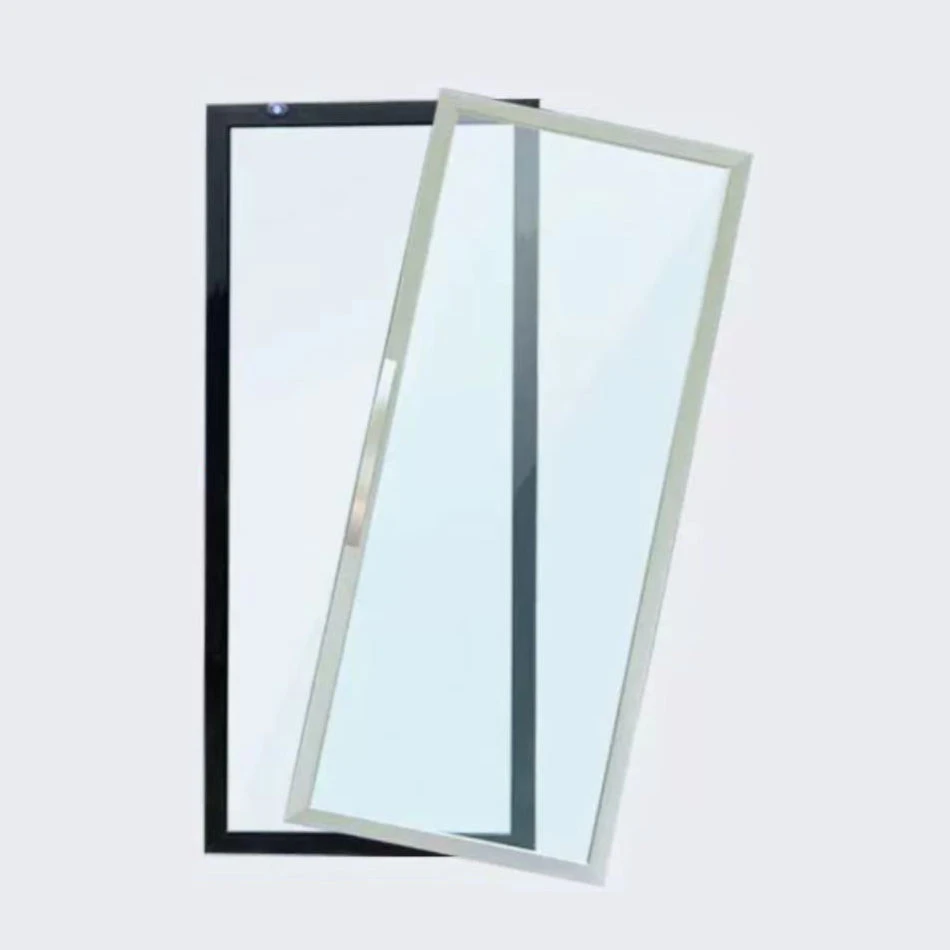
Tempered glass used in commercial refrigeration must meet recognized international safety standards. The most commonly referenced standards include:
EN 12150 (Europe): Specifies fragmentation testing requirements for thermally toughened soda-lime silicate safety glass. A standard test area of 50mm × 50mm must contain a minimum of 40 particles — ensuring that breakage produces small, harmless granules rather than large sharp pieces.
ASTM C1048 (USA): Covers heat-treated flat glass, including fully tempered and heat-strengthened varieties. Fully tempered glass must have a surface compression of at least 69 MPa (10,000 psi).
China 3C Certification: Mandatory safety certification for tempered glass products sold in the Chinese market, verifying fragmentation performance and surface compression.
Huayin Glass products comply with all three standards. Our tempering process is certified under ISO 9001:2015 quality management, and SGS audit reports are available upon request. Learn more about our manufacturing capabilities and quality control systems.
Reliable tempering quality depends on rigorous process control at every stage. At Huayin, we monitor surface stress using a differential surface refractometer (DSR) on every production batch, verify fragmentation patterns through periodic destructive testing per EN 12150 protocols, check bow and edge lift against tolerance specifications for curved products, and inspect for optical distortion, roller wave, and surface defects before packaging. These checkpoints are non-negotiable — a single batch of improperly tempered glass in a supermarket freezer can create serious safety and liability risks for the end brand.
Q: Can tempered glass be cut or drilled after tempering?
A: No. Tempered glass must be cut, drilled, and edged to final dimensions before the tempering process. Any post-tempering modification will cause the glass to shatter. This is why accurate technical drawings are essential at the quoting stage.
Q: What causes spontaneous breakage in tempered glass?
A: Spontaneous breakage is typically caused by nickel sulfide (NiS) inclusions in the glass substrate — microscopic impurities that expand over time and can trigger fracture. Heat-soak testing (HST) per EN 14179-1 accelerates this failure mechanism under controlled conditions, weeding out susceptible panels before shipment. Huayin offers heat-soak testing as an optional quality assurance step for high-risk applications.
Q: What is the maximum size for curved tempered glass?
A: Our forced convection bending furnace handles curved tempered glass up to 2440mm × 1500mm. Radius ranges from gentle arcs to deep U-bends, with ±1.0mm radius tolerance. Contact us with your drawing for a technical feasibility assessment — see our thermally bent glass range for more options.
Huayin Glass Solutions operates both flat and curved tempering furnaces in our 6,000+ sqm facility in Foshan, Guangdong — making us one of the few glass deep-processing manufacturers in southern China capable of handling the full spectrum of tempered glass products for commercial refrigeration. From flat appliance panels to multi-radius curved display fronts, every product is manufactured to your drawings, your specifications, your quality standards. All products are ISO 9001:2015 and China 3C certified, exported to 50+ countries worldwide.
Send us your specifications. We deliver safety-certified precision.
Request a Quote: Online Inquiry | Website: huayinglass.com
Huayin Glass Solutions — 25 Years of Custom Glass Deep Processing | Foshan, Guangdong, China | Curved Tempered Glass | Tempering Process | Hot Bending Glass | EN 12150 / ASTM C1048 / 3C Certified | Export to 50+ Countries
Add:No. 16 Xingye Road, Beijiao Town Industrial Park, Shunde District, Foshan City, Guangdong Province
PHONE: +86 13509957538
TEL: +86 0757-26131933
Email: huayin_glass@163.com

© 2026 Huayin Glass Solutions All Rights Reserved.


