


 Add:No. 16 Xingye Road, Beijiao Town Industrial Park, Shunde District, Foshan City, Guangdong Province
 PHONE: +86 13509957538
 TEL: +86 0757-26131933
 Email: huayin_glass@163.com

Chinese


An insulated glass unit — an IGU — is two or more panes separated by a sealed spacer frame holding a dry gas space. On a refrigerator or display cabinet it decides how much heat enters, whether the exterior fogs, how heavy the door becomes, and how long the assembly lasts before the cavity turns cloudy. It is also the spec buyers pin down least often. This guide sets out the decisions in order.
Five elements can be specified separately: the panes, the coating, the spacer that sets the gap, the primary and secondary sealants, and the desiccant. Buyers often specify only the first two and leave the rest to the supplier — which is where much of the price variation comes from.
The cavity is the working part. If the edge seal fails, moisture migrates in, the desiccant saturates, and the unit hazes — at which point it cannot be repaired. That is why commercial freezer glass should be judged on seal construction as much as on thermal data.
Double-glazed units dominate mid-temperature cabinets; triple-glazed two-cavity units are standard below minus 18°C. The reason is not simply that more glass insulates better. In a low-temperature cabinet the inner pane drops far below the ambient dew point, and a second cavity decouples the exterior pane from that cold surface — lifting outer face temperature and reducing both heat gain and fogging, at the cost of weight that then changes hinge and frame selection.
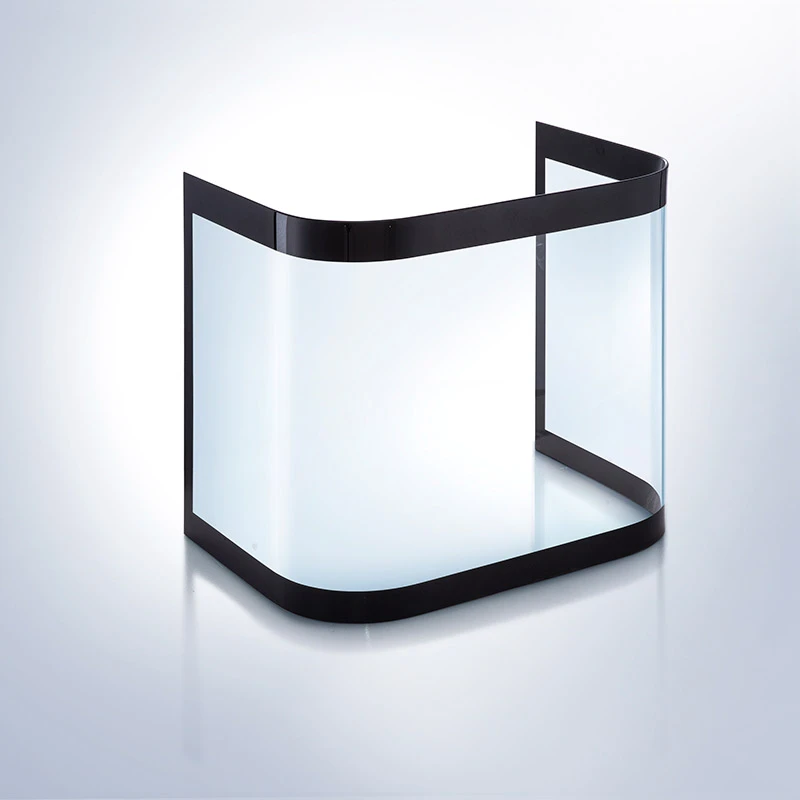
Low-E is a thin metallic oxide layer that reflects long-wave infrared while staying largely transparent. It blocks the radiant path by which warm surroundings heat the cabinet, cutting compressor load without darkening the display.
Position matters more than buyers expect. The coating must face the cavity, and the correct surface number depends on cavity count and climate. A coating on the wrong face looks identical and passes inspection while underperforming — so write the surface number into the drawing, not into a conversation. Heated and curved variants sit under hot bent insulated heating glass.
Argon is the default fill: denser than air, lower conductivity, cheap relative to the gain. Cavity width follows a curve, not a line — too narrow and conduction dominates, too wide and convection cells circulate. A mid-range gap balances both for door-sized panels; wider is not automatically better.
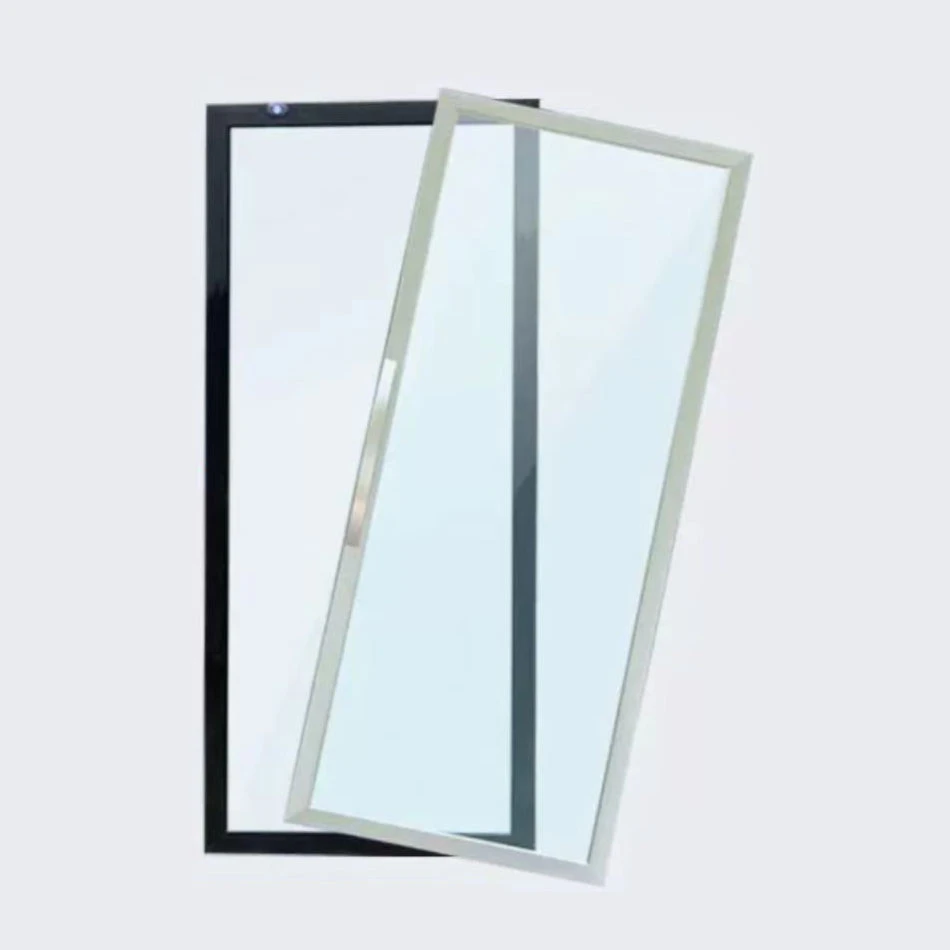
The spacer is the least visible and most consequential part of the unit: it sets the gap, holds the desiccant, and forms the thermal bridge between panes.
Aluminium conducts heat readily, creating a cold band around the perimeter — exactly where condensation and frost appear first. Warm-edge spacers use a low-conductivity or hybrid construction to raise edge temperature and push that threshold outward.
A production unit carries two seals: a butyl primary seal controlling vapour transmission, and a secondary sealant of polysulphide, polyurethane or silicone providing structural integrity. Early failures are almost always secondary seal problems rather than glass problems. Freezer doors open dozens of times per shift, so the edge seal flexes continuously — a fatigue environment, not a static one.
The table maps typical door applications to a reasonable starting configuration. It is a basis for technical discussion, not a substitute for it.
| Application | Typical IGU configuration | Watch point |
|---|---|---|
| Beverage cooler, 0-8°C | Double pane, Low-E, argon | Exterior fogging in humid stores |
| Pastry display cabinet | Double pane, Low-E, low-iron glass | Colour fidelity under display lighting |
| Wine cooler cabinet | Double or triple, Low-E, argon | UV and light exposure to labels |
| Vertical freezer, -18°C | Triple pane, two cavities, Low-E | Door weight versus hinge rating |
| Low-temperature freezer, -22°C | Triple pane, warm-edge spacer, heated option | Edge condensation and frost band |
The last two rows differ less in glass than in edge construction and heating. Below minus 18°C the perimeter governs; buyers who specify only "triple glazed" often end up with frost at the frame because the spacer was never discussed.
A specification that can be manufactured without further clarification contains: dimensions and tolerances; pane thickness and glass type per position, including low-iron where colour matters; coating type and surface number; cavity width and gas concentration; spacer material and desiccant; both sealants; edge deletion width; the applicable safety standard; and test reports due at delivery.
Two of these are routinely omitted and cause most disputes — the coated surface number and the edge deletion width. Both are invisible at goods-in inspection but determine whether the coating survives sealing. For how the frame interacts with the unit, see our guide to refrigerator glass doors and the track-mounted sliding glass door format for wide openings.
Q: Is a triple-glazed unit always better than double?
A: No. Below minus 18°C the third pane earns its cost. For beverage coolers and pastry cabinets a well-built double unit with Low-E and argon performs adequately, and the lighter door is easier on hinges and gaskets.
Q: Can a failed IGU be repaired?
A: No. Once the cavity is contaminated or the desiccant saturated, the unit must be replaced — which is why sealant specification deserves more attention at ordering than it usually gets.
Q: How do I verify gas fill concentration?
A: Ask for the concentration at manufacture and the measurement method. Argon can be verified non-destructively on finished units, so a supplier who cannot report a figure is not measuring it.
Huayin Glass Solutions assembles insulated glass units in-house, combining Low-E coating, argon filling, warm-edge spacers and optional ITO heating layers, then builds them into wine cooler cabinet glass and pastry display cabinet glass assemblies. The Beijiao, Shunde facility in Foshan covers 6,000+ square meters, holds ISO 9001:2015 and China CCC, and exports to 50+ countries.
Send your door drawing and target cabinet temperature for an IGU configuration proposal: contact our engineering team.
Further reading: Commercial supermarket freezer glass · Curved tempered coated heated IG glass · Manufacturing capability · ITO versus defogging coating comparison
Add:No. 16 Xingye Road, Beijiao Town Industrial Park, Shunde District, Foshan City, Guangdong Province
PHONE: +86 13509957538
TEL: +86 0757-26131933
Email: huayin_glass@163.com

© 2026 Huayin Glass Solutions All Rights Reserved.


