


 Add:No. 16 Xingye Road, Beijiao Town Industrial Park, Shunde District, Foshan City, Guangdong Province
 PHONE: +86 13509957538
 TEL: +86 0757-26131933
 Email: huayin_glass@163.com

Chinese


A magnetic door gasket is a flexible PVC or TPE profile with an embedded magnet strip that closes the gap between a refrigerator glass door and the cabinet flange, holding the door shut through magnetic attraction while blocking cold-air leakage. On commercial freezer doors it is the single component that most directly controls infiltration losses, condensation at the frame, and door rebound behavior. This brief defines the six parameters that determine gasket performance and the specification items a buyer should verify before ordering.
Gasket performance begins with the cross-section. A production profile has three functional zones: the dart (the rigid fin that inserts into the door frame slot), the bellows section (the collapsible part that compresses against the cabinet flange), and the magnet cavity.
The dart must grip the slot with enough interference to prevent pull-out during door travel, yet release without tearing during service replacement. Dart height, barb angle, and slot width are matched dimensions — a gasket designed for a 2.0 mm slot will not seal correctly in a 2.5 mm slot even if it can be forced in.
Bellows depth defines the sealing gap range. A deeper bellows absorbs more frame-to-glass variation across a door batch, which matters for refrigerator glass doors assembled from tempered panels with normal production tolerances.
Standard PVC compounds stiffen as temperature drops. On a freezer door operating at -18°C and below, an over-hard compound stops conforming to the flange, and the seal line develops micro-gaps that leak cold air and frost over.
| Parameter | What it controls | What to verify |
|---|---|---|
| Shore hardness | Conformability of the bellows | Value specified for freezer range, not ambient |
| Low-temp flexibility | Sealing recovery at -18°C and below | Cold-bend test data for the compound |
| PVC vs TPE base | Stiffening slope and durability | TPE compounds hold flexibility lower |
| Aging resistance | Multi-year service life | UV and plasticizer-migration data |
The compound choice should be made against the cabinet temperature class, not against cost alone. A gasket rated for a beverage cooler will underperform on a low-temperature display freezer.
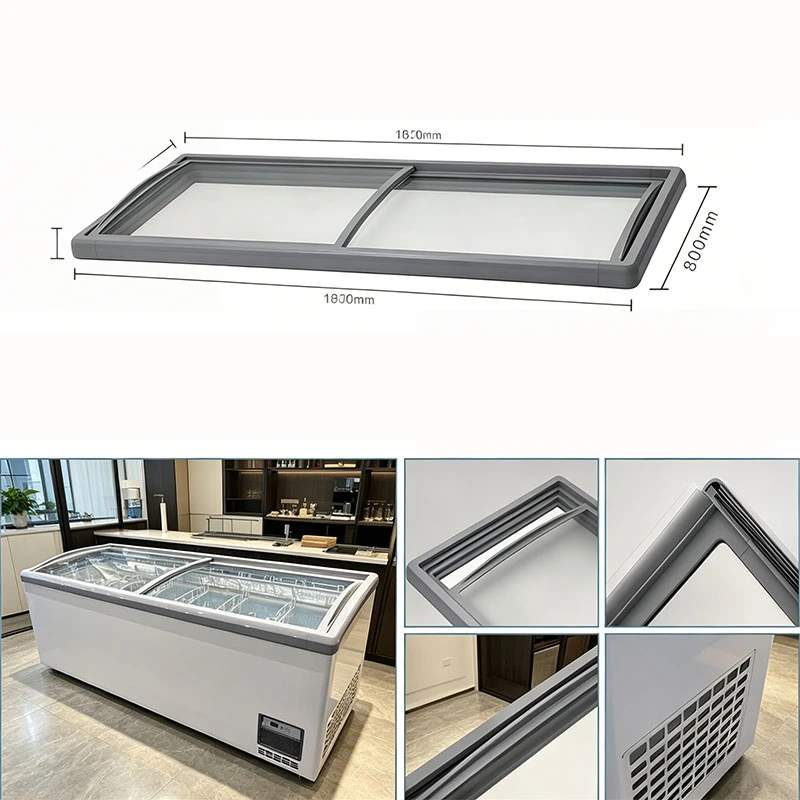
The magnet strip does two jobs: it holds the door closed against the gasket's own rebound, and it resists the air-pressure differential trying to push the door open on a freezer. Retention force is a measurable specification, not a feel.
Too little magnetic force and the door drifts open or fails to self-close; too much and customers — and hinge springs — fight the door every time. The balance point depends on door weight and hinge spring torque, so magnet grade and hinge selection should be specified together.
On glass doors the magnet cavity sits within the gasket body at a fixed offset from the panel edge. Changing the glass thickness or edgework without checking the magnet offset shifts the seal line and weakens retention.
Compression set measures how much of the gasket's thickness is permanently lost after being squeezed for a long period. A gasket with high compression set flattens against the flange over months of door-closed storage and transport, then leaks once the cabinet enters service.
For freezer doors, where doors may sit closed for long shipping periods before commissioning, low compression set is a first-order specification. Ask suppliers for compression-set values at the operating temperature range, and specify a maximum in the purchase contract rather than accepting "good recovery" as a description.
A gasket frame is only as tight as its corners. Welded corners keep the seal continuous through the highest-stress points of the door; poorly welded corners open micro-gaps exactly where leakage is most visible — frost lines at the door corners are the classic field symptom.
| Corner condition | Field symptom | Verification method |
|---|---|---|
| Continuous welded seam | No corner frost, even door rebound | Visual + paper-strip pull test at corners |
| Weak or porous weld | Frost line at door corners | Low-power magnification of the seam |
| Miter-cut without weld | Gap grows after thermal cycling | Gap measurement before and after cycling |
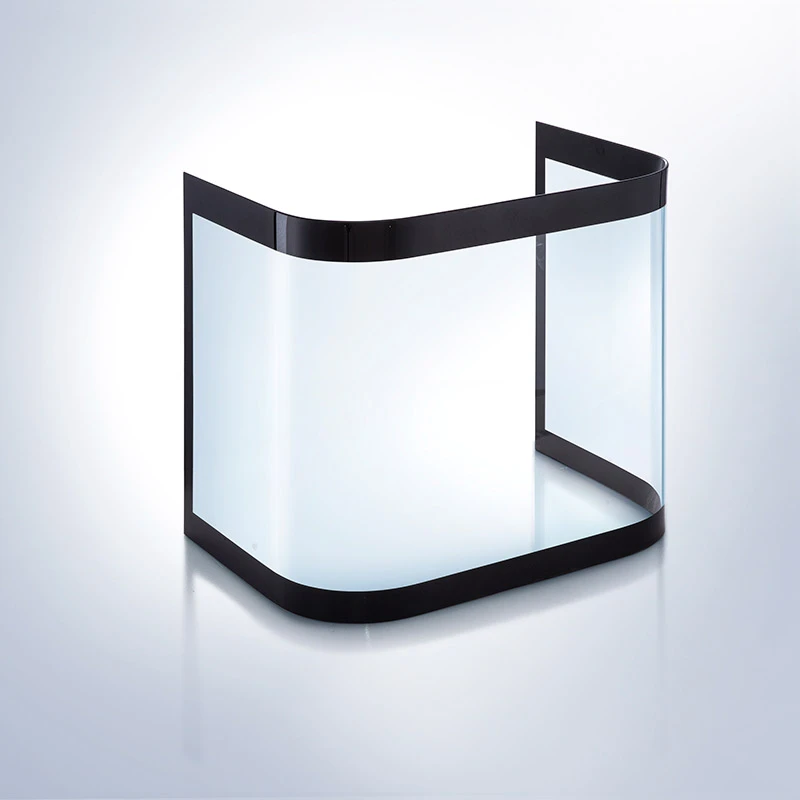
Gasket and glass are mating parts. Panel thickness, edge grinding style, and corner radius all enter the gasket drawing. When door glass is sourced separately from the gasket, tolerance mismatch shows up as darts that will not seat or bellows that never touch the flange.
Sourcing the glass door assembly and the magnetic door gasket from one manufacturer closes this tolerance chain: panel edgework, slot dimensions and gasket profile are drawn against the same set of dimensions. This is the practical reason one-stop accessories supply outperforms split procurement on freezer door projects.
| Term | Definition |
|---|---|
| Dart | Rigid fin on the gasket that inserts into the door frame slot for mechanical retention |
| Bellows | Collapsible section of the gasket that compresses against the cabinet flange to seal |
| Shore hardness | Standardized measure of compound stiffness, correlated with low-temperature conformability |
| Compression set | Permanent thickness loss after prolonged compression, expressed as a percentage |
| Retention force | Magnetic force holding the closed door against the flange, measured per unit length |
| Paper-strip test | Simple seal check: paper pulled from a closed door should show uniform resistance along the seal line |
Three questions separate a specification-driven gasket supplier from a catalog seller: Can they state compound hardness and low-temp flexibility for the freezer range? Can they match the gasket drawing to your glass panel edgework and frame slot? Can they supply compression-set and retention-force data with the shipment?
Huayin Glass Solutions, founded in 2002 and based in Beijiao Industrial Park, Shunde, Foshan, Guangdong, operates a 6,000+ m² plant certified to ISO 9001:2015 and China CCC, supplying custom glass door assemblies with matching gaskets, hinges and hardware to buyers in 50+ countries. Pairing the gasket specification with the glass manufacturing process in one order removes the tolerance handoff entirely.
Further reading: Client Cases · Featured Projects · Commercial Supermarket Freezer Glass · ITO Glass vs Defogging Coating
Add:No. 16 Xingye Road, Beijiao Town Industrial Park, Shunde District, Foshan City, Guangdong Province
PHONE: +86 13509957538
TEL: +86 0757-26131933
Email: huayin_glass@163.com

© 2026 Huayin Glass Solutions All Rights Reserved.


