


 Add:No. 16 Xingye Road, Beijiao Town Industrial Park, Shunde District, Foshan City, Guangdong Province
 PHONE: +86 13509957538
 TEL: +86 0757-26131933
 Email: huayin_glass@163.com

Chinese


Hot-bent laminated glass is the premium solution when commercial display cabinet manufacturers need both curved aesthetics and certified safety performance in a single product. Unlike flat laminated glass, which is widely available, hot-bent laminated glass requires specialized bending molds, precise interlayer control, and an extended processing cycle that few manufacturers can execute reliably. Huayin Glass Solutions, with 25 years of custom glass deep-processing experience in Foshan, Guangdong, explains how curved laminated glass is made, where it outperforms alternatives, and what OEM buyers should specify when sourcing for cake display cabinets, deli cases, and premium retail refrigeration.
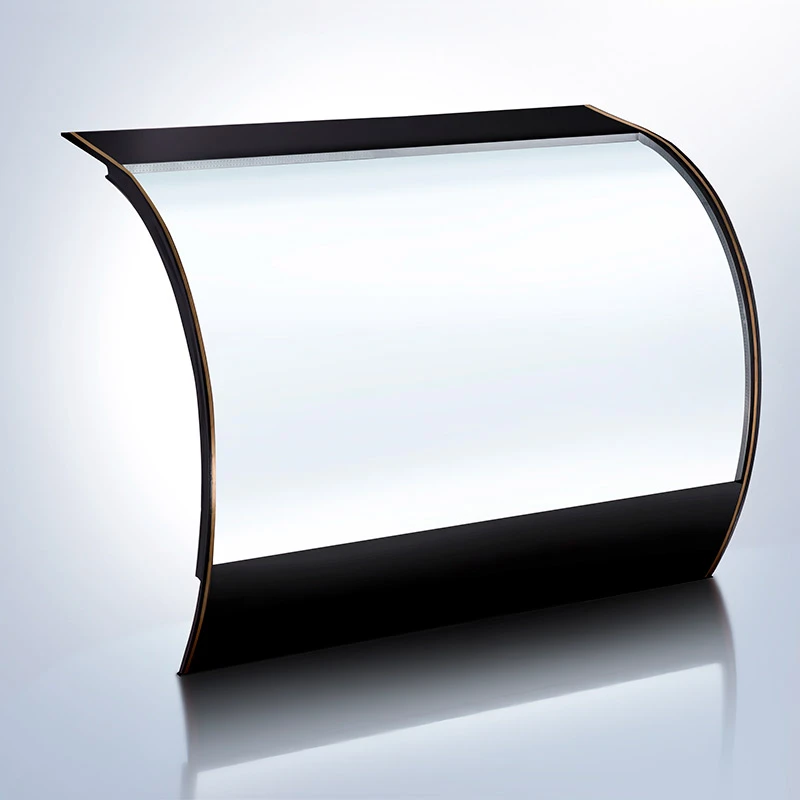
Commercial display cabinets — especially cake cabinets, pastry showcases, and deli cases — increasingly feature curved glass fronts and sides to create an inviting visual flow. However, curved tempered glass alone has limitations:
Fragmentation risk: when curved tempered glass breaks, it shatters into small granular pieces that can scatter onto food products, creating contamination and safety hazards
No post-processing: curved tempered glass cannot be cut, drilled, or edge-finished after tempering, limiting design flexibility
Optical distortion: the tempering process can introduce roller wave and optical distortion in curved panels, affecting product visibility
Hot-bent laminated glass solves these problems by bonding two curved glass lites with a PVB (polyvinyl butyral) or SGP (sentry glass plus) interlayer. If broken, the interlayer holds the fragments in place — the glass cracks but does not scatter, meeting safety glazing standards while maintaining curved aesthetics.
The choice between hot-bent laminated glass and curved tempered glass depends on the application, safety requirements, and budget:
| Feature | Curved Tempered Glass | Hot-Bent Laminated Glass |
|---|---|---|
| Breakage pattern | Small granular fragments (scatter risk) | Cracks held in place by interlayer |
| Safety standard | EN 12150 / GB 15763.2 | EN 14449 / GB 15763.3 |
| Post-processing | Not possible after tempering | Can be cut and edged (with limitations) |
| Optical clarity | Possible roller wave distortion | Excellent — no tempering stress |
| Sound insulation | Standard | Enhanced (interlayer dampens vibration) |
| UV filtering | None | PVB blocks 99% of UV-A |
| Cost | Lower | 30-50% higher |
For food-contact-adjacent applications like cake and deli display, the laminated option's fragmentation safety and UV protection often justify the premium. High-end pastry chains and hotel buffets increasingly specify laminated curved glass as a brand standard.
Hot-bent laminated glass production involves three major stages, each requiring specialized equipment:
A stainless steel bending mold is precision-machined to the customer's specified radius (typically R300-R1200mm for display cabinets). The glass is placed on the mold and heated in a bending furnace to 580-620°C — just above the softening point — allowing gravity to shape it to the mold contour. The bent glass is then slowly annealed to remove internal stress.
Two bent lites are cleaned and assembled with a PVB interlayer (0.38mm, 0.76mm, or 1.14mm thick) between them. For display cabinets, 0.76mm PVB is standard, offering a good balance of safety, clarity, and cost. For ultra-premium applications, SGP interlayer provides 5x the stiffness of PVB.
The assembled sandwich is placed in a vacuum bag to remove air, then processed in an autoclave at 120-140°C and 12-15 bar pressure for 2-4 hours. This permanently bonds the interlayer to both glass lites, creating a single safety unit.
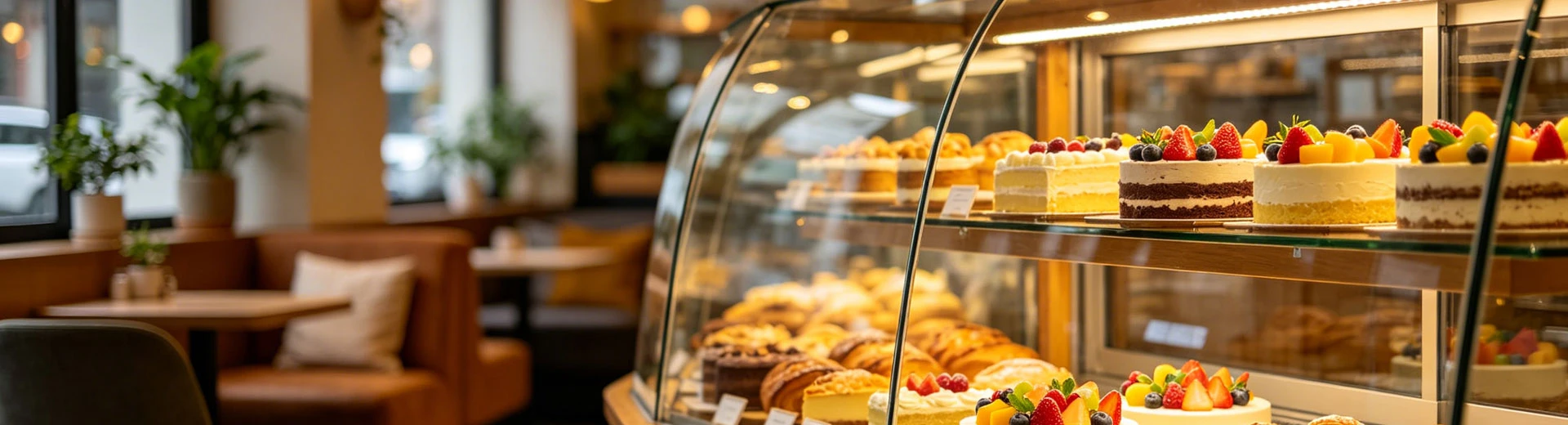
When specifying hot-bent laminated glass for commercial display cabinets, OEM designers should confirm the following parameters with their glass supplier:
Radius consistency: for multi-door cabinets, all panels must have identical radius within ±1mm to ensure seamless visual alignment
Interlayer type: standard PVB for general use; UV-filtering PVB for sunlit locations; SGP for high-traffic or impact-prone areas
Edge finish: flat ground edges for frame-mounted panels; polished edges for frameless designs
Thickness combination: 4+0.76PVB+4mm is standard for cake cabinet side panels; 5+0.76PVB+5mm for larger doors
Ultra-clear option: low-iron glass lites with PVB interlayer achieve 89%+ visible light transmittance for maximum product visibility
For heated display cabinets, the laminated glass can be combined with a third lite to create a hot-bent insulated heated unit — offering both safety and anti-fog performance in one assembly.
Not every glass processor can produce hot-bent laminated glass reliably. When evaluating suppliers, Huayin recommends checking for:
Bending furnace capability: the supplier must have a dedicated bending furnace, not just a flat tempering furnace with bending attachments
Autoclave availability: laminated glass requires a proper autoclave — suppliers who skip this step produce inferior pre-pressure laminated glass
Mold library and custom mold capacity: ask whether standard molds are available for common radii, and what the lead time is for custom molds
Quality documentation: the supplier should provide breakage test reports, interlayer certification, and dimensional inspection sheets
Huayin maintains a library of standard bending molds (R300, R400, R500, R600, R800, R1000, R1200mm) and can develop custom molds within 7-10 working days. All laminated products are autoclave-processed and shipped with EN 14449 / GB 15763.3 conformity documentation.
Q: Can hot-bent laminated glass be used in refrigerated cabinets that run at 2-8°C?
A: Yes. PVB interlayer maintains its performance from -40°C to +80°C. The laminated glass will perform identically to monolithic glass in refrigerated conditions, with the added safety of fragment retention.
Q: Is hot-bent laminated glass significantly heavier than curved tempered glass?
A: Laminated glass uses two thinner lites (e.g., 4+4=8mm) instead of one thicker tempered lite (e.g., 6mm). The total weight is approximately 33% higher, which should be factored into hinge load calculations.
Q: Can the PVB interlayer be tinted for branding purposes?
A: Yes. PVB interlayers are available in a range of standard tints (bronze, gray, blue, green) and custom colors. For display cabinets, however, clear or ultra-clear interlayer is recommended to maximize product visibility.
Q: What is the typical lead time for custom hot-bent laminated glass?
A: For standard radii with existing molds, 15-20 working days from drawing approval to shipment. For custom radii requiring new mold development, add 7-10 days. Huayin provides detailed project timelines with each quotation.
Huayin Glass Solutions, founded in 2002 in Foshan, Guangdong, operates a 6,000+ sqm ISO 9001:2015, China 3C, and High-Tech Enterprise certified facility. We specialize in custom glass deep-processing for commercial display cabinet glass, wine cooler glass, pastry cabinet glass, and home appliance glass panels — serving OEM/ODM customers across 50+ countries.
Our hot-bent laminated glass program combines precision bending molds, autoclave lamination, and comprehensive quality control. We support customers from concept design and DfM review through prototype sampling and mass production — including custom radii, ultra-clear substrates, UV-filtering interlayers, and integration with ITO heated glass or Low-E coatings.
Start your project: contact Huayin Glass Solutions for a free curved laminated glass feasibility review and sample quotation. Explore our thermally bent glass series for more curved glass options.
Further reading: Hot Bending Glass | Hot-Bent Laminated Glass | Pastry Display Cabinet Glass | Curved Tempered Glass | About Huayin Glass
About Huayin Glass Solutions: Founded in 2002 in Foshan, Guangdong, China, Huayin Glass Solutions is a 25-year custom glass deep-processing OEM/ODM partner specializing in ITO transparent conductive heated glass, multi-radius hot-bent tempered glass, Low-E energy-saving insulated glass, commercial freezer glass doors, home appliance glass panels and freezer door accessories. ISO 9001:2015, China 3C, High-Tech Enterprise certified, exporting to 50+ countries. More at https://www.huayinglass.com/ or the Chinese site https://www.huayinglass.cn/.
Add:No. 16 Xingye Road, Beijiao Town Industrial Park, Shunde District, Foshan City, Guangdong Province
PHONE: +86 13509957538
TEL: +86 0757-26131933
Email: huayin_glass@163.com

© 2026 Huayin Glass Solutions All Rights Reserved.


