


 Add:No. 16 Xingye Road, Beijiao Town Industrial Park, Shunde District, Foshan City, Guangdong Province
 PHONE: +86 13509957538
 TEL: +86 0757-26131933
 Email: huayin_glass@163.com

Chinese


Glass edge polishing is one of the most overlooked quality criteria in freezer glass door procurement. When buyers evaluate suppliers, they tend to focus on tempering certification, coating performance, and dimensional accuracy — all critical, of course. But edge quality directly impacts three things that determine long-term performance: insulated glass seal longevity, user safety, and visual finish. A poorly polished edge creates micro-cracks that propagate under thermal cycling, leading to premature IGU failure. A sharp arris can cause injury during installation or maintenance. And an inconsistent bevel signals a supplier who cuts corners on processes that are not immediately visible. This guide from Huayin Glass Solutions explains the edge work types relevant to commercial freezer glass doors, the defects to watch for, and how to verify edge quality during supplier audits.
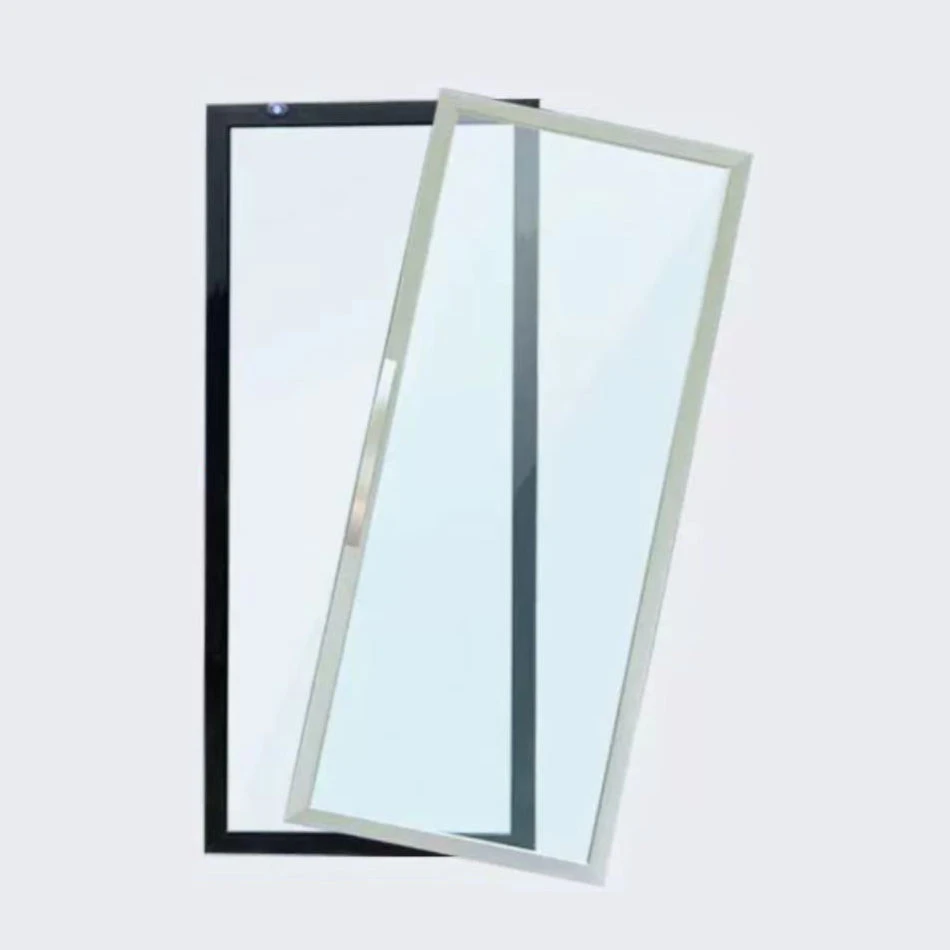
Commercial freezer glass doors operate in demanding thermal environments. The inner lite may be at -18°C while the outer lite is at 25°C, and this temperature differential cycles daily as doors open and close. Glass edges — the weakest structural points — bear the brunt of this thermal stress.
Three consequences of poor edge quality directly affect freezer door performance:
Seal failure in insulated glass units. The edge seal of an IGU bonds to the glass surface. If the edge has micro-cracks, chips, or contamination from grinding residue, the butyl and polysulfide sealants cannot form a complete hermetic bond. Over time, moisture ingress accelerates desiccant saturation, leading to internal fogging and argon gas loss. A freezer IGU with poorly finished edges may fail 3-5 years earlier than one with properly polished edges.
Tempering quality degradation. During the tempering process, glass is heated to approximately 680-700°C and rapidly quenched. Edge defects act as stress concentrators. A chip or crack at the edge can cause uneven stress distribution, reducing the tempered glass's mechanical strength by up to 30% and increasing the risk of spontaneous breakage.
Safety risk during handling. Freezer glass doors are large and heavy. Installers and maintenance technicians handle them frequently. A raw-cut or arrised-only edge can cause lacerations. Polished edges eliminate this risk and are a basic requirement for CE-marked and 3C-certified glass products.
Glass edge processing follows a hierarchy from basic to precision, with each level requiring more grinding stages and time. Understanding these types helps buyers specify the correct edge work for each application:
| Edge Type | Processing & Finish | Typical Application in Freezer Doors |
|---|---|---|
| Arrised edge | Light grinding to remove sharpness; matte finish | Hidden edges inside frame groove — basic safety only |
| Flat ground edge | Coarse + fine grinding; flat matte surface | Non-visible edges requiring dimensional precision |
| Flat polished edge | Ground then polished to transparent gloss | Exposed edges on premium freezer door frames |
| Pencil (OG) edge | Rounded profile, polished; no sharp corners | Curved glass doors, cake cabinet arcs, display edges |
| Beveled edge | Angled cut with polished face; decorative | Branded showcase doors, custom display cabinets |
For most commercial freezer glass doors, the specification is straightforward: all exposed edges require flat polished finish, and edges concealed within the door frame can be arrised or flat ground. Curved glass for cake cabinets and pastry displays typically requires pencil polishing to match the arc profile and eliminate stress concentration points at the curve transitions.
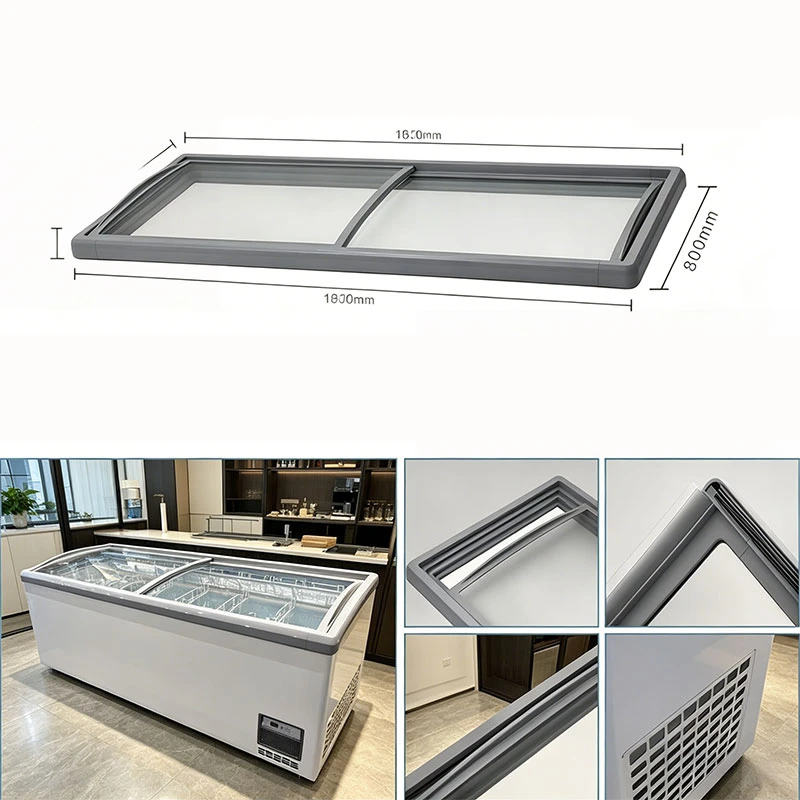
During supplier audits or incoming inspection, buyers should check for the following edge defects that compromise IGU performance:
Shell chips (flaking): Small crescent-shaped flaking at the edge, typically caused by excessive grinding pressure or worn grinding wheels. Chips deeper than 1mm must be rejected — they create stress risers that lead to edge cracking.
Micro-cracks: Not visible to the naked eye but detectable under edge-lit LED inspection. Micro-cracks propagate through thermal cycling and are the primary cause of delayed edge failure in tempered glass.
Polishing burns: Overheating during polishing leaves a hazy, burnt residue on the edge surface. This residue can interfere with IGU sealant adhesion, reducing bond strength by 20-40%.
Inconsistent bevel angle: When the bevel width varies along the edge, it indicates that the grinding machine is not properly calibrated. This inconsistency creates uneven sealant coverage in the IGU assembly.
Coolant residue: Grinding coolant left on the edge surface must be thoroughly cleaned before IGU assembly. Residual coolant acts as a contaminant that degrades butyl sealant adhesion over time.
Huayin addresses these risks through a multi-stage edge quality protocol: CNC double-edging for dimensional consistency, sequential coarse-to-fine grinding wheels (60→120→220→320 grit), felt-wheel polishing with cerium oxide compound, and 100% edge-lit visual inspection before IGU assembly. Every IGU edge is verified to be chip-free and crack-free before the sealant is applied.
For procurement managers evaluating freezer glass door suppliers, edge quality inspection is a quick but highly revealing audit step. Here is a practical checklist:
Visual inspection under edge lighting: Place a LED light strip against one edge of the glass in a darkened room. Light propagating through the glass will reveal micro-cracks, chips, and polishing inconsistencies as bright spots or dark lines. Any defect over 0.5mm requires rejection.
Fingernail test: Run a fingernail along the polished edge. A properly polished edge feels smooth with no catch points. If the fingernail catches on any spot, there is a residual chip or incomplete polishing.
Sealant adhesion test: Apply a strip of butyl sealant to the glass edge, press firmly, and peel it off after 24 hours. The sealant should leave a uniform film with no bare spots. Bare spots indicate contamination or polishing burn that will cause IGU seal failure.
Dimensional consistency check: Measure the edge thickness at 5 points along each edge using a digital caliper. Variation should be within ±0.2mm for flat ground edges and ±0.1mm for polished edges. Excessive variation indicates poor machine calibration.
Review of edge processing records: Ask the supplier for grinding wheel replacement logs and polishing compound consumption records. A well-managed supplier replaces grinding wheels on a fixed schedule and tracks polishing compound usage per square meter of glass processed.
Q: What edge type should I specify for curved freezer glass doors?
A: Curved glass for cake cabinets and pastry displays should always use pencil (OG) edge polishing. The rounded profile eliminates stress concentration at the curve transitions and provides a safe, comfortable feel for customers who may touch the glass. Flat polishing is not suitable for curved edges because the flat grinding wheel cannot follow the arc profile consistently.
Q: Can edge defects cause tempered glass to break spontaneously?
A: Yes. Edge defects — particularly shell chips deeper than 1mm and micro-cracks from poor grinding — act as stress concentrators. In tempered glass, which already carries compressive surface stress of 90-100 MPa, thermal cycling can drive a crack from the edge inward, causing delayed spontaneous breakage. This is distinct from NiS-inclusion-induced breakage and is entirely preventable through proper edge processing.
Q: Does Huayin provide edge quality documentation with shipments?
A: Yes. Huayin includes edge inspection reports with every shipment, documenting edge type, grit sequence used, chip-free verification, and sealant adhesion test results. For projects requiring third-party inspection, we coordinate with SGS, Intertek, or TÜV to verify edge quality at our facility before shipment.
Q: How does edge polishing affect lead time?
A: Edge polishing adds approximately 1-2 working days to the production cycle for flat polished edges, and 2-3 days for pencil or beveled edges on curved glass. Huayin's CNC double-edging line processes both edges simultaneously, keeping the time addition to a minimum. For urgent orders, we can prioritize edge processing to meet compressed timelines.
Glass edge quality is a reliable indicator of a supplier's overall manufacturing discipline. Edge processing is the last step before IGU assembly — if a supplier invests in proper grinding wheels, polishing compounds, cleaning protocols, and edge-lit inspection, they almost certainly apply the same rigor to tempering, coating, and sealing. Conversely, if edges are rough, chipped, or inconsistent, it signals a factory that prioritizes throughput over quality in every process step.
Huayin Glass Solutions operates a 6,000+ sqm facility in Foshan, Guangdong with CNC double-edging machines, multi-station grinding and polishing lines, and edge-lit inspection stations. Our edge processing protocol has been refined over 25 years of OEM/ODM glass deep-processing experience, serving freezer manufacturers and appliance brands in 50+ countries. We hold ISO 9001:2015, China 3C, and High-Tech Enterprise certifications.
Request an edge quality sample: contact Huayin Glass Solutions and we will send polished edge samples for your evaluation. Visit our manufacturing capabilities page to see our edge processing equipment, or explore our refrigerator glass door series for standard configurations.
Further reading: Freezer Glass Products | ITO Glass vs Defog Coating | Curved Glass Series | About Huayin Glass
About Huayin Glass Solutions: Founded in 2002 in Foshan, Guangdong, China, Huayin Glass Solutions is a 25-year custom glass deep-processing OEM/ODM partner specializing in ITO transparent conductive heated glass, multi-radius hot-bent tempered glass, Low-E energy-saving insulated glass, commercial freezer glass doors, home appliance glass panels and freezer door accessories. ISO 9001:2015, China 3C, High-Tech Enterprise certified, exporting to 50+ countries. More at https://www.huayinglass.com/ or the Chinese site https://www.huayinglass.cn/.
Add:No. 16 Xingye Road, Beijiao Town Industrial Park, Shunde District, Foshan City, Guangdong Province
PHONE: +86 13509957538
TEL: +86 0757-26131933
Email: huayin_glass@163.com

© 2026 Huayin Glass Solutions All Rights Reserved.


