


 Add:No. 16 Xingye Road, Beijiao Town Industrial Park, Shunde District, Foshan City, Guangdong Province
 PHONE: +86 13509957538
 TEL: +86 0757-26131933
 Email: huayin_glass@163.com

Chinese


Energy consumption is the single largest operating cost for any supermarket, convenience store, or foodservice operator running a fleet of refrigerated display cabinets. Up to 60% of that cooling load escapes through the glass doors — and that is exactly where Low-E argon-filled insulated glass delivers the biggest payback. This guide explains the physics behind Low-E coatings, the role of argon gas fill, the impact of warm-edge spacers, and the trade-offs between double-pane and triple-pane designs. It is written for OEM procurement managers, refrigeration engineers, and energy-efficiency consultants sourcing commercial freezer glass from a China glass manufacturer with 25 years of deep-processing experience.
Heat transfer across a glass door happens through three mechanisms — conduction, convection, and radiation — and an insulated glass unit (IGU) has to fight all three to keep the cabinet cold and the storefront clear of condensation.
Conduction is heat moving through solid materials. A single pane of 4mm glass conducts heat at roughly 1.0 W/m²K, which means an unprotected door in a -18°C freezer can pull 50-80W of heat per square meter into the cabinet just from conduction. A sealed air gap between two panes cuts conduction dramatically because air is a poor conductor.
Convection is heat carried by moving air. In a single-pane door, cold air literally slides down the inside surface while warm room air rises — creating a continuous loop that pulls heat inward. Filling the cavity with a denser, less conductive gas like argon suppresses this loop.
Radiation is the silent killer. Even with the air gap, the inner surface of the outer pane radiates infrared energy directly into the cabinet. A bare glass surface has an emissivity of about 0.84, meaning 84% of the radiant heat passes straight through. A Low-E coating knocks that emissivity down to 0.04-0.15 — slashing the radiation component by 80-90%.
Low-E (low emissivity) is a microscopically thin metallic oxide layer — typically silver-based — deposited onto one surface of the glass via magnetron sputtering under vacuum. The layer is invisible to the human eye but acts as a selective mirror: visible light passes through almost unimpeded (transmittance 80-90%), while long-wave infrared radiation is reflected back to its source.
Two main Low-E families exist, and they behave very differently once integrated into an IGU.
Hard-coat (pyrolytic) Low-E is fused into the glass surface during manufacture at ~620°C. It is durable, can be stored and handled like regular glass, and is suitable for single-pane applications. Emissivity is typically 0.15-0.20.
Soft-coat (sputtered) Low-E is deposited at room temperature in a vacuum chamber. Emissivity is much lower (0.04-0.08), giving better thermal performance, but the coating is delicate and must be enclosed inside the IGU cavity, never exposed to weather or abrasion.
For commercial freezer doors, soft-coat Low-E placed on surface #2 (interior face of the outer pane) is the standard configuration. A typical refrigerator glass door built with soft-coat Low-E reaches a center-of-glass U-value of 1.1 W/m²K — about half that of a non-coated double-pane IGU.
Independent field studies on European supermarket freezer cabinets show that upgrading from clear double-pane glass to Low-E double-pane glass reduces door-area heat ingress by 35-45%. Adding argon fill pushes that to 50-55%. In tropical climates where ambient temperatures reach 35-40°C, the absolute kWh savings are even larger because the temperature differential driving the heat flow is bigger.
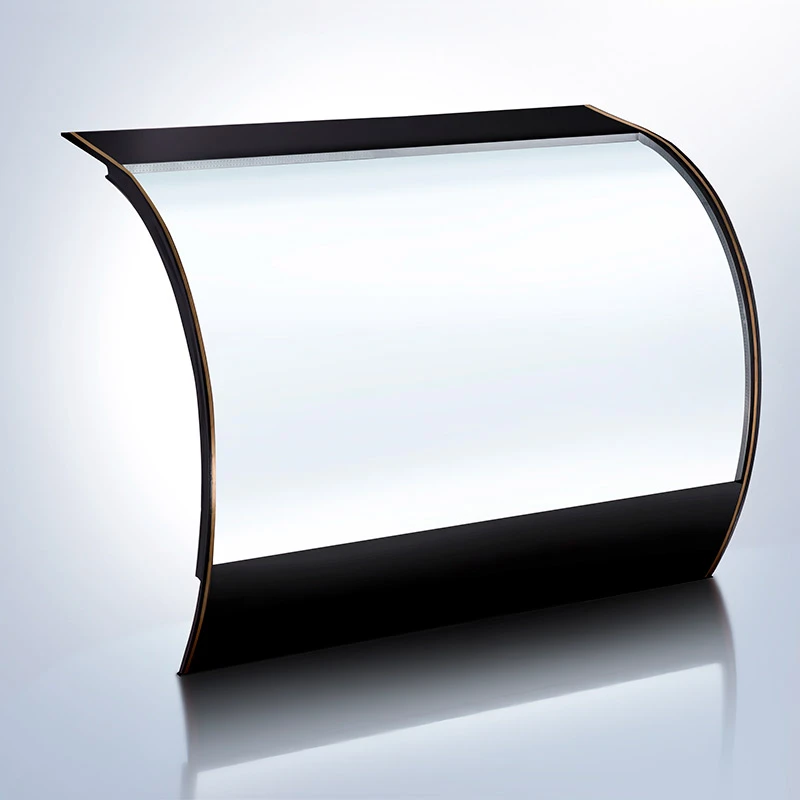
Argon is a colorless, odorless, non-toxic inert gas that is roughly 1.4 times denser and 30% less conductive than air. When sealed inside an IGU cavity, it suppresses convective currents and slows conductive heat transfer, delivering an extra 5-15% improvement in U-value on top of the Low-E coating benefit.
Most IGU manufacturers quote "argon-filled" without specifying the actual concentration. The industry standard is a minimum 90% argon concentration at the time of manufacture. Over a 15-20 year service life, slow diffusion through the butyl sealant typically drops the concentration to 70-80% by year 10 and 50-60% by year 20. The thermal performance degrades in parallel.
Serious manufacturers use an online spark-test spectrometer at the gas-fill station to measure argon concentration in real time. Less rigorous suppliers fill by pressure or volume only, which can result in 60-70% concentration even on a brand-new unit. As a buyer, you should request:
The name and model of the gas-fill station;
Whether an inline concentration monitor is installed;
The factory's IGU gas-retention warranty (typically 10 years above 80%, 15 years above 70%);
Spark-test readings from the actual production batch.
For more on the broader IGU quality-control framework, see our earlier piece on ITO glass vs defogging coating, which touches on related vacuum-process controls.
Even the best Low-E + argon IGU loses performance around its perimeter. A traditional aluminum spacer conducts heat 700 times faster than the insulated cavity, creating a cold strip at the glass edge where condensation can form. This is the "thermal bridge" problem.
Warm-edge spacers — made from stainless steel, thermoplastic, or foam-based composites — break that thermal bridge. The result is two-fold:
Higher overall U-value because the edge is no longer a heat leak.
Higher internal surface temperature at the edge, which prevents condensation from forming on the inside face of the glass during humid store conditions.
For tropical and high-humidity environments — Southeast Asia, the Gulf region, equatorial Africa — warm-edge spacers are not optional; they are mandatory to prevent the door glass from fogging up at its perimeter, even when the center-of-glass U-value is excellent.
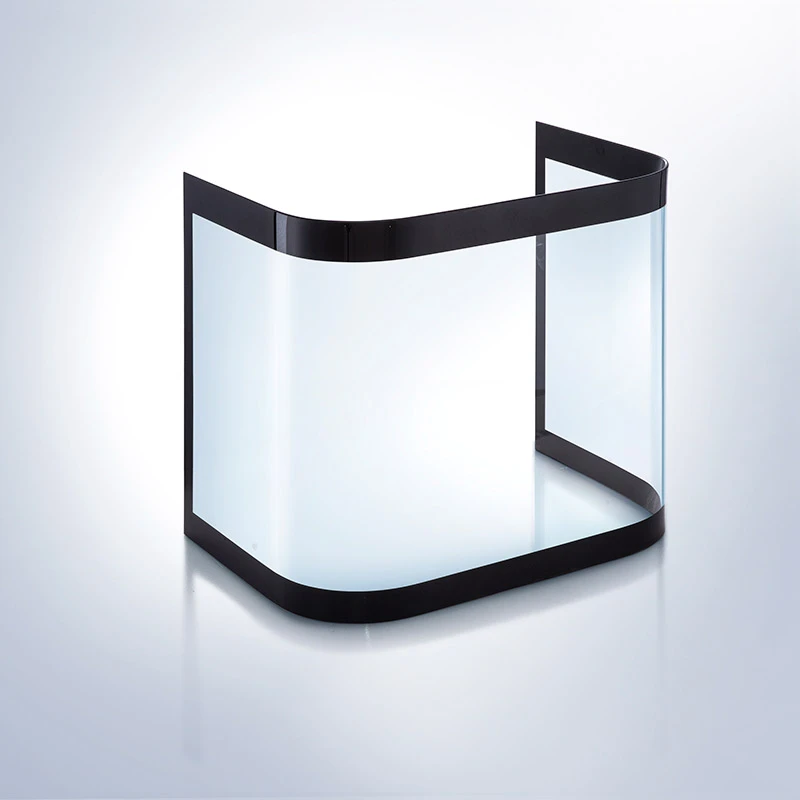
The table below summarizes the four most common IGU configurations used in commercial freezer doors. All values assume soft-coat Low-E on surface #2, 90% argon fill, and warm-edge spacers.
| Configuration | Center-of-Glass U-value | Typical Application |
|---|---|---|
| Double-pane, no Low-E, air fill | 2.8 W/m²K | Legacy single-temp coolers, budget imports |
| Double-pane, Low-E, argon fill | 1.1-1.4 W/m²K | Standard commercial freezers (0°C to -25°C) |
| Triple-pane, 2× Low-E, argon fill | 0.6-0.8 W/m²K | Ultra-low-temp freezers (-25°C to -40°C), EU EPREL Class A |
| Triple-pane, 2× Low-E, krypton fill | 0.4-0.5 W/m²K | Pharmaceutical cold storage, laboratory freezers |
The krypton-filled option exists but is rarely used in commercial refrigeration because the gas cost is 5-8 times that of argon and the payback rarely justifies it. For most supermarket and convenience-store applications, double-pane Low-E + argon or triple-pane Low-E + argon is the sweet spot.
When sourcing Low-E insulated glass from a China OEM manufacturer, build the following items into your supplier evaluation.
Ask which Low-E base glass is being used. Premium brands include Pilkington, AGC, Saint-Gobain, and Guardian. If the supplier purchases coated glass from a reputable coater, you inherit the coater's warranty. If they coat in-house, request coating-line videos and a third-party emissivity test report.
Standard cavity widths are 12mm, 16mm, and 20mm. Argon's efficiency peaks around 16mm — wider or narrower cavities reduce its benefit. For triple-pane, two 12mm cavities typically outperform one 24mm cavity at the same total thickness.
Low-E coating must be "deleted" (abraded away) around the perimeter so the butyl sealant bonds to bare glass, not to the coating. Verify that edge-deletion width meets the sealant supplier's recommendation — typically 8-10mm. Missing or inconsistent edge deletion is the most common cause of premature IGU seal failure.
Match the configuration to your operating environment. Tropical and high-humidity sites need warm-edge spacers as a baseline. Cold-climate sites (Northern Europe, Canada) can sometimes justify triple-pane for the extra U-value. For a related breakdown of climate-specific configurations, refer to our guide on Huayin's manufacturing capabilities.
Q: Does Low-E glass have a noticeable color tint?
A: Modern soft-coat Low-E is essentially colorless — most observers cannot distinguish it from clear glass under normal store lighting. Hard-coat Low-E may show a very faint bluish or amber hue, depending on viewing angle.
Q: Will the argon leak out of the IGU?
A: Yes, slowly. Industry-standard IGU warranties cover gas retention for 10-15 years. After 20+ years, the concentration typically stabilizes around 50-60%, still meaningfully better than air but below original specification.
Q: Can Low-E glass be combined with ITO heated defog coating?
A: Yes. Huayin routinely builds triple-function IGUs that combine Low-E coating, argon fill, and ITO heating film. Each function occupies a different glass surface inside the cavity, with no interference.
Q: How much extra does Low-E + argon cost versus standard double-pane?
A: In OEM quantities, Low-E soft-coat + argon fill adds roughly 15-25% to the unit cost of a standard double-pane IGU. The energy savings pay back this premium in 18-36 months for most retail refrigeration applications.
For most commercial refrigeration applications — supermarket freezer aisles, convenience-store coolers, beverage merchandisers, cake and wine display cabinets — a double-pane Low-E argon-filled insulated glass with a warm-edge spacer is the optimal starting point. Step up to triple-pane only when extreme cold (-30°C and below) or strict energy-class mandates demand it.
As an OEM/ODM glass deep-processing partner based in Guangdong, China, Huayin Glass Solutions has supplied energy-efficient insulated glass to refrigeration brands across 50+ countries. Our 6,000 m² factory in Shunde, Foshan, runs a fully automated IGU line with inline argon-concentration monitoring, soft-coat Low-E handling, and warm-edge spacer assembly. We support custom drawings, small-batch sampling, and full-container export to North America, Europe, the Middle East, Africa, Southeast Asia, and Latin America.
Ready to specify Low-E argon-filled insulated glass for your next project? Contact our engineering team for samples, drawings review, and a tailored quotation.
→ Contact Huayin Glass Solutions for samples and OEM quotation
Add:No. 16 Xingye Road, Beijiao Town Industrial Park, Shunde District, Foshan City, Guangdong Province
PHONE: +86 13509957538
TEL: +86 0757-26131933
Email: huayin_glass@163.com

© 2026 Huayin Glass Solutions All Rights Reserved.


