


 Add:No. 16 Xingye Road, Beijiao Town Industrial Park, Shunde District, Foshan City, Guangdong Province
 PHONE: +86 13509957538
 TEL: +86 0757-26131933
 Email: huayin_glass@163.com

Chinese


Curved tempered glass has become the defining visual element of modern commercial freezers, pastry cabinets, and wine coolers. For overseas buyers and domestic appliance brands, finding the right curved tempered glass factory in China means balancing aesthetics, safety, energy efficiency, and supply-chain reliability. This guide explains what to look for in a custom curved tempered glass supplier, from bending capabilities and tempering quality to IGU assembly and OEM/ODM project management. Whether you are sourcing a single SKU or building a full freezer door assembly program, these checkpoints will help you qualify a supplier before placing mass-production orders.
Retail environments are increasingly designed around visual merchandising. A curved glass door on a freezer or display cabinet creates a premium, seamless look that flat glass cannot match. Beyond aesthetics, curved tempered glass offers structural advantages: the curved profile resists external impact better than flat panels of the same thickness, and the smooth radius reduces the risk of corner chips during daily operation.
For appliance OEMs, curved glass also enables design differentiation. A custom radius, silk-screened brand frame, ambient LED lighting, or an integrated transparent display can turn a standard freezer into a branded sales tool. This is why procurement teams increasingly search for a custom curved tempered glass supplier capable of co-developing curved door assemblies rather than simply cutting flat sheets.

Not every glass factory can produce repeatable curved tempered glass. Ask whether the supplier uses a forced-convection tempering furnace with a flexible bending section, and whether they own CNC-cut molds for standard radii. A capable curved glass manufacturer should be able to produce radii from 300 mm up to several meters and accommodate both convex and concave geometries.
Tempering is what gives curved glass its safety properties. Fully tempered curved glass must meet fragment-count standards such as EN 12150 or ASTM C1048, with surface compression typically ≥90 MPa. Request third-party test reports and check whether the factory runs heat-soak testing (HST) to reduce the risk of NiS inclusion failure in the field.
For freezer applications, curved tempered glass is usually only one component of an insulated glass door. Look for a supplier that can combine curved tempered outer lite, Low-E coating, argon filling, warm-edge spacer, and ITO heated inner lite into a finished IGU. One-stop assembly reduces tolerance stack-up and shortens lead times.
Brand differentiation often requires ceramic frit borders, gradient printing, or custom LOGO placement. Verify the supplier's screen-printing line supports high-temperature ceramic ink and color matching within ΔE ≤ 2.0 against a master sample.
Buyers frequently underestimate the complexity of multi-radius curved glass. A single-radius bend is straightforward: one constant radius along one axis. A multi-radius design—common in premium wine coolers and display cabinets—combines several radii or a compound curve, requiring custom molds and precise furnace profiling.
| Feature | Single-Radius Curved Glass | Multi-Radius Curved Glass |
|---|---|---|
| Mold cost | Lower; standard radii often available | Higher; custom CNC molds required |
| Lead time | 2–3 weeks for samples | 3–5 weeks for first article |
| Typical use | Economy freezer doors, beverage coolers | Premium wine coolers, display cabinets |
| Design flexibility | Limited to one radius | Enables complex 3D surfaces and brand differentiation |
| MOQ impact | Easier to meet low MOQ | Higher MOQ due to mold investment |
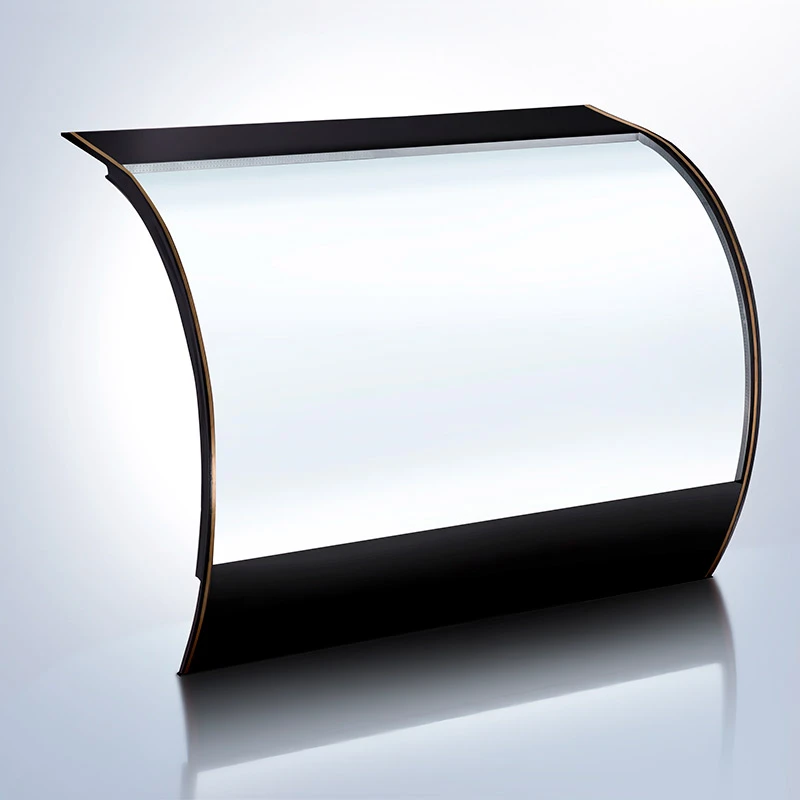
The glass is first cut to size, edge-polished, and washed. It is then heated in a bending furnace to approximately 620–650°C, shaped over or into a mold, and rapidly quenched with high-pressure air. The quenching creates compressive stress on the surfaces and tensile stress in the center, giving the glass its safety characteristics. Because curved glass cools unevenly across the radius, furnace parameters must be tuned for each radius and thickness combination.
For freezer doors, the most common coatings are Low-E (low emissivity) and ITO (indium tin oxide) for anti-fog heating. Low-E coatings reduce radiative heat transfer and improve energy efficiency, while ITO film provides transparent electric heating. A high-performance freezer glass door may combine both: Low-E on the outer lite and ITO on the inner lite.
Curved IGU assembly demands tight edge alignment and consistent cavity width. The spacer is bent to match the radius, primary butyl seal is applied, and secondary structural seal completes the perimeter. Argon is then filled to a concentration of 90% or higher to suppress convective heat transfer. Any leakage at the curved corners will degrade thermal performance and cause internal condensation.
Before releasing mass-production shipments, experienced buyers request the following verification items from their China curved glass manufacturer:
Dimensional report: radius, chord length, height, thickness, and edge straightness within drawing tolerances (typically ±1.0 mm for radius, ±0.5 mm for hole positions).
Fragmentation test: confirm compliance with EN 12150, ASTM C1048, or GB 15763.2.
Surface stress test: GASP polarimeter or scattered-light measurement showing surface compression ≥90 MPa.
Optical inspection: no roller-wave distortion beyond acceptable limits, no visible scratches, chips, or coating defects in the viewing area.
IGU dew-point and gas retention: initial argon concentration ≥90%; dew point ≤ -40°C.
Packaging audit: ISPM 15 wooden crates, corner protection, and separation film to prevent glass-to-glass contact during ocean freight.
Pricing for curved tempered glass is driven by mold investment, glass thickness, radius complexity, coating type, and order volume. A simple single-radius 4 mm clear curved tempered panel may start at relatively low volume pricing, while a multi-radius Low-E/ITO IGU assembly for a premium pastry display cabinet will carry significantly higher unit cost.
Typical MOQ structures from a curved tempered glass factory in China are:
Standard radius samples: 5–10 pieces for prototyping.
Custom radius first article: 50–100 pieces to amortize mold cost.
Mass production: 300–500 pieces per SKU for competitive unit pricing.
Buyers should also budget for tooling amortization over the first 1,000–3,000 pieces and negotiate whether molds remain the buyer's property.
Q: What is the difference between hot bent glass and curved tempered glass?
A: Hot bent glass is heated and shaped but not tempered; it breaks into large shards and is not safety glass. Curved tempered glass undergoes the same shaping followed by rapid quenching, producing small, relatively harmless fragments upon breakage.
Q: Can curved tempered glass be used for heated freezer doors?
A: Yes. ITO or wire-based heating elements can be integrated into curved insulated glass units to prevent condensation in freezer and refrigerator applications.
Q: How do I verify a supplier's bending capability before placing an order?
A: Request sample parts in your target radius, review their furnace and mold photos, and ask for third-party test reports on tempered glass safety standards.
Q: What is the typical lead time for a custom curved glass door assembly?
A: Sample lead time is usually 2–4 weeks; mass production ranges from 4–8 weeks depending on radius complexity, coating requirements, and order volume.
Sourcing curved tempered glass from China for commercial freezer OEM/ODM programs requires more than comparing unit prices. The right custom curved tempered glass supplier should demonstrate proven bending and tempering capabilities, in-house IGU assembly, consistent quality control, and transparent project management.
Huayin Glass Solutions, based in Foshan, Guangdong, operates a 6,000+ m² facility specializing in multi-radius curved tempered glass, Low-E/ITO coated insulated glass, and complete freezer door assemblies. With 25 years of experience and exports to 50+ countries, we support appliance brands and cold-chain manufacturers from prototype to mass production. If you are looking for a reliable curved tempered glass factory in China, contact us for a sample and quotation.
Further reading: ITO Glass vs Defogging Coating Comparison · Freezer Glass Products · Wine Cooler Glass Door
Add:No. 16 Xingye Road, Beijiao Town Industrial Park, Shunde District, Foshan City, Guangdong Province
PHONE: +86 13509957538
TEL: +86 0757-26131933
Email: huayin_glass@163.com

© 2026 Huayin Glass Solutions All Rights Reserved.


