


 Add:No. 16 Xingye Road, Beijiao Town Industrial Park, Shunde District, Foshan City, Guangdong Province
 PHONE: +86 13509957538
 TEL: +86 0757-26131933
 Email: huayin_glass@163.com

Chinese


A supermarket freezer aisle is the toughest environment any piece of glass will ever face. Doors swing open 200+ times a day, blast cold at -25 °C meets shop-floor 25 °C and 70 % RH, frozen-food packaging loses color under careless lighting, and 50,000-hour LED strips run hot on the door perimeter. Modern supermarket freezer glass has to beat all of those problems at once: zero fog, U-value below 1.0 W/m²K, accurate color rendering for product photography, and enough thermal headroom for embedded LED lighting. This technical guide breaks down the three engineering stacks — ITO transparent conductive heating, Low-E coating, and argon-filled insulated glass — that together define a high-performance freezer door for frozen-food retail.
Walk into any supermarket frozen aisle and the glass doors are quietly doing more work than the compressor. They have to keep frost off, hold the cold in, light the product properly, and survive the physical abuse of shopping-cart impacts and continuous door swings. Three engineering targets dominate the specification:
Visibility. A door that fogs during rush hour costs the retailer sales. The fog point is when the inner glass surface temperature drops below the local dew point — typically 5 °C to 12 °C below ambient — exactly the condition created by a -25 °C cabinet behind a 25 °C shop.
Energy efficiency. Glass-on-glass conduction is the largest thermal bridge in any freezer door. Each additional watt of heat leak costs the retailer roughly $0.20–0.40 per year in compressor duty. Modern supermarket regulations (EU EPREL 2027 included) push U-value targets below 1.0 W/m²K.
LED compatibility. Door-edge LED strips now run at 110 °C junction temperatures with 50,000-hour design life. The glass must absorb that heat, diffuse it evenly, and survive the temperature cycling without yellowing or seal failure.
Solving all three at once requires stacking technologies — and every layer adds manufacturing risk that must be engineered out.
The first and most visible layer is ITO electric heating defog. A magnetron-sputtered Indium Tin Oxide film is deposited on the inner surface of the front glass, with silver-paste bus bars screen-printed along the long edges and a flexible tail taking 24 V or 230 V AC to the controller.
Commercial supermarket doors use a sheet resistance window of 5–15 Ω/□. At that level, 24 V drives a power density of 200–600 W/m² across the active area — enough to hold the inner surface 8 °C above dew point in most climates, without overheating the cabinet contents.
On large reach-in doors, the upper third of the panel is closer to the top evaporator coil and sees more aggressive condensation risk. Premium supermarket freezer glass door designs split the panel into two or three independently-controlled zones, wired to a humidity sensor outside the door frame. The controller applies full power only when humidity exceeds 65 %, holding average power draw under 50 W/m² over a 24-hour cycle.
ITO's appeal over resistive wire meshes is optical. Visible-light transmittance stays above 80 %, even when the heating layer is paired with a Low-E stack. By contrast, nichrome-wire defog patterns look like a 1 mm grid through the door and force retailers to design around them.
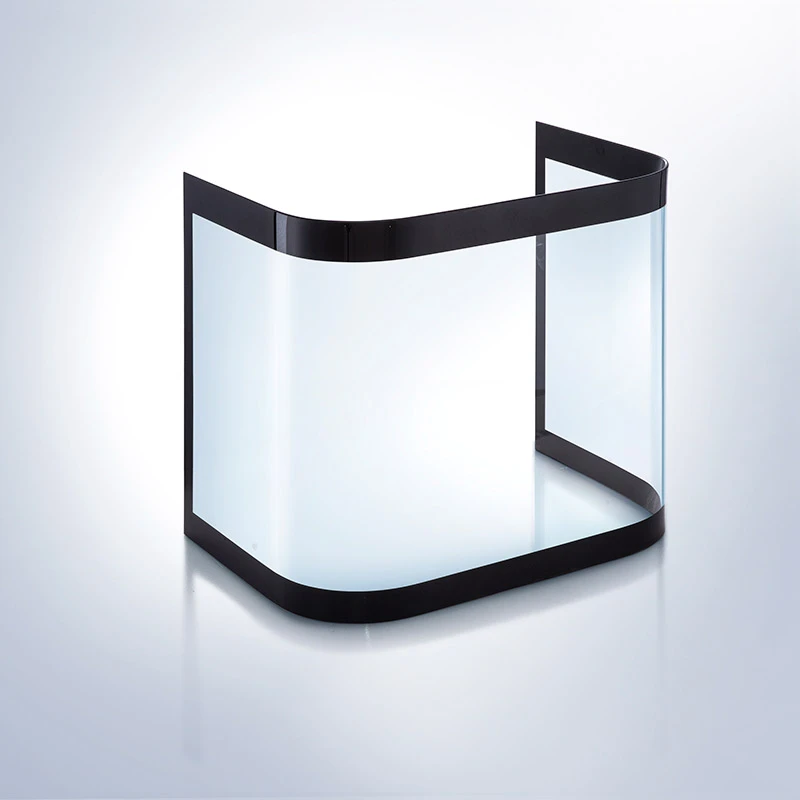
Defog gets the door clear; Low-E and argon keep it that way by reducing the heat that wants to come through.
A soft-coat (sputtered) Low-E layer sits on face 2 or face 3 of the insulated glass unit. Emissivity drops from 0.84 (clear float) to 0.02–0.05, cutting radiative heat transfer by roughly an order of magnitude. For supermarket use, soft-coat is preferred over hard-coat because of the higher visible transmittance — frozen food packaging colors stay accurate.
The 14–18 mm cavity between the two glass plies is filled with argon at ≥90 % initial concentration. Argon's lower thermal conductivity (0.017 W/m·K versus air at 0.025 W/m·K) cuts the cavity's conductive share. A warm-edge spacer with a 0.25 W/m·K conductivity replaces the traditional aluminum box, removing the cold bridge at the perimeter where most heat actually leaks.
A premium 4 mm + 16 mm Ar + 4 mm Low-E IGU on a typical supermarket reach-in door achieves a center-of-glass U-value of 1.0 W/m²K and an overall door U-value around 1.3 W/m²K. Compared to a single-pane unit at 5.8 W/m²K, that is an 80 % reduction in heat leak — and over a 10-year operating life, the energy saving repays the upgrade cost several times over.
The perimeter is the most overlooked engineering challenge. Even with a perfect IGU, glass-to-frame conduction is a one-dimensional heat leak that drives the edge of the glass below dew point and produces the classic "fog band" 50 mm in from the frame.
Stainless-steel warm-edge spacers with integrated desiccant reduce the frame-side conduction path to 0.20–0.25 W/m·K. Combined with a thermally-broken aluminum or PVC frame, the temperature of the inner glass edge can be held 4–6 °C warmer than with a traditional alloy box spacer.
Some premium freezer doors include a thin etched or printed heater strip around the perimeter of the ITO panel — essentially a lower-power zone that runs 24/7 and prevents edge fog. The strip is wired to a separate low-voltage tap, so its power draw is negligible compared to the main ITO zone.
| Engineering attribute | Standard single-pane | Mid-tier dual-pane | Premium ITO + Low-E |
|---|---|---|---|
| Center-of-glass U-value | 5.8 W/m²K | 2.7 W/m²K | 1.0 W/m²K |
| Defog mechanism | None | Wire mesh | ITO + edge heat |
| Visible transmittance | 89 % | 78 % | 82 % |
| Argon-filled cavity | No | Optional | Yes (≥90 %) |
| Compatible with 50,000 h LED | Limited | Partial | Yes |
| 10-year energy cost per door | $1,400 | $720 | $310 |
LED strip lighting along the door perimeter is now the supermarket norm — 4,000 K neutral white for frozen food, 3,000 K warm for wine cabinets. But LED strips impose three extra requirements on the glass:
Heat resistance of the inner ply. A typical 14 W/m LED strip runs the perimeter glass at 50–60 °C in continuous operation. Inner plies in premium supermarket doors use a low-iron substrate and tempered finish rated to 100,000 thermal cycles between -30 °C and +70 °C without seal failure.
UV containment. LEDs produce little UV, but the silver-paste bus bars and the silicone edge seal are UV-sensitive. Premium doors wrap the seal with a UV-stable secondary barrier or specify UV-blocking Low-E on the inner cavity face.
Diffusion. Direct view of LEDs creates spotting on the door. Frosted or low-iron inner plies spread the LED light into a uniform wash and let the merchandiser control beam angle with a simple silk-screen mask.
A useful supermarket glass specification breaks down into ten items the buyer should pin in writing:
Center-of-glass U-value target (typical: ≤1.0 W/m²K).
IGU gas-fill retention (≥80 % at 5 years).
ITO sheet resistance tolerance (±10 %).
Defog full-power time to clear (≤90 seconds from cold start).
Visible-light transmittance (≥80 %).
Color rendering index through the IGU (Ra ≥ 90 for fresh food, ≥ 80 for frozen).
Edge temperature delta versus dew point (≥ 5 °C).
Impact resistance class (EN 12600 1B1 minimum).
LEED / EPREL 2027 compliance documentation.
Serial traceability for each door.
For OEM freezer door buyers who need to verify these on incoming shipments, our free manufacturing capability overview includes the test protocols we run on every production batch.
Q: How long does an ITO + Low-E freezer door last in supermarket service?
A: With proper installation and annual gasket inspection, the IGU structure itself lasts 15+ years. The ITO heater, gasket and LED strip are field-replaceable, so the door can return to service for 25+ years before any glass needs to be replaced.
Q: Can ITO heating be retrofitted to an existing single-pane freezer door?
A: Not without replacing the entire IGU. The ITO layer is sputtered into the surface during manufacturing. Retrofit options are limited to external anti-fog films, which lack the optical clarity of an in-glass ITO layer.
Q: What's the difference between soft-coat and hard-coat Low-E for supermarket use?
A: Soft-coat (sputtered) has lower emissivity (0.02–0.05) and higher visible transmittance, ideal for high-performance freezer doors. Hard-coat (pyrolytic) is more durable and easier to handle but has higher emissivity (around 0.15). Premium supermarket doors always use soft-coat on face 2 or 3.
Q: How does argon retention actually get verified?
A: Two methods are commonly accepted: a spark tester that measures gas concentration non-destructively, or a long-term accelerated test that compares gas-chromatograph readings at production and after high-temperature storage. Premium China freezer glass manufacturer documentation includes both.
Modern supermarket freezer glass is a tightly engineered stack: ITO transparent heating for visibility, Low-E coating for radiative control, argon-filled IGU for conductive control, and warm-edge framing for perimeter integrity. A buyer who specifies all four layers and verifies them on each shipment will roughly halve the energy bill compared to a single-pane baseline — and never have to apologize for a fogged door during peak shopping hours.
If you are specifying a new supermarket roll-out, refurbishing an existing fleet, or evaluating a China freezer glass manufacturer for OEM production, our team is ready to help with engineering drawings, prototype samples, and full specification support. Contact Huayin Glass to request a specification packet or schedule a video walk-through of our production lines.
Further reading: Supermarket Freezer Glass Catalog · Manufacturing Capabilities · Featured Projects · Contact Us
Add:No. 16 Xingye Road, Beijiao Town Industrial Park, Shunde District, Foshan City, Guangdong Province
PHONE: +86 13509957538
TEL: +86 0757-26131933
Email: huayin_glass@163.com

© 2026 Huayin Glass Solutions All Rights Reserved.


