


 Add:No. 16 Xingye Road, Beijiao Town Industrial Park, Shunde District, Foshan City, Guangdong Province
 PHONE: +86 13509957538
 TEL: +86 0757-26131933
 Email: huayin_glass@163.com

Chinese


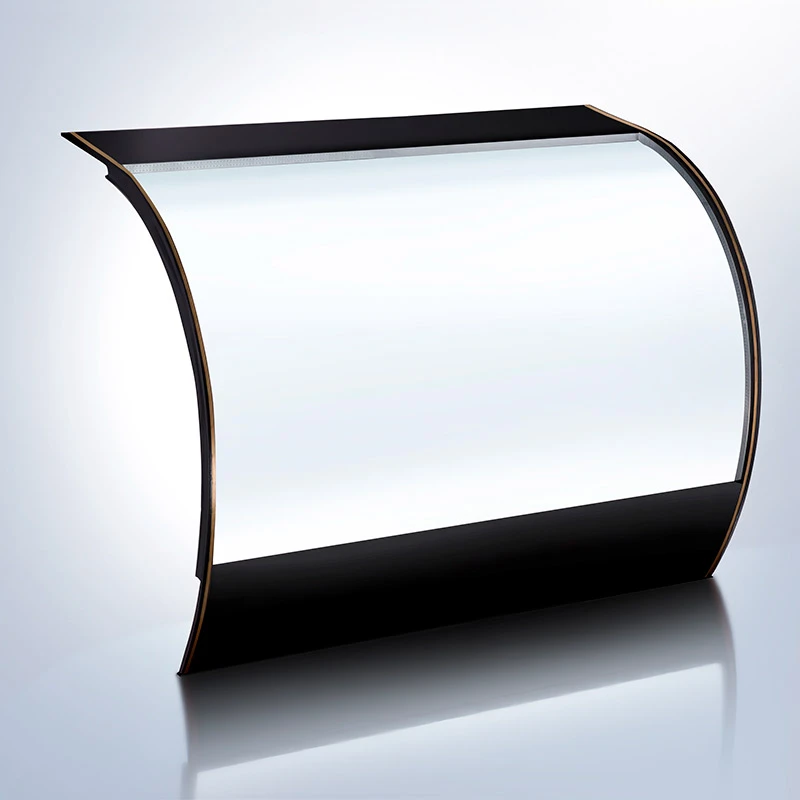
A curved defogging glass panel is a bent tempered glass panel carrying a transparent conductive coating — typically ITO — that holds the exterior surface above the ambient dew point, preventing condensation on curved display cabinet doors. Unlike flat anti-fog solutions, a curved panel adds two engineering constraints: the coating must survive the bending and tempering sequence, and heat uniformity must be maintained across a non-planar surface. This brief defines the seven parameters that decide whether a curved defogging design performs in service.
The governing rule of curved heated glass manufacturing: the conductive coating is deposited on the flat substrate first, then fired together with the glass through the bending and tempering cycle. Coating after forming is not viable — a post-tempering film either fails to adhere or locally anneals the tempered surface, destroying the compressive stress profile that gives safety glass its fragment pattern.
This sequencing constraint matters commercially. It means the coating supplier, the bending tooling, and the tempering line must be controlled under one quality system. Factories that only coat flat glass and outsource bending cannot guarantee film integrity across a multi-curvature curved tempered panel.
Single-radius panels are the standard production case; multi-curvature (compound) bends are producible but require dedicated tooling and should always be validated at sample stage. Radius verification at incoming inspection uses a chord-and-rise gauge against the approved sample.
| Parameter | Typical production range | Buyer verification |
|---|---|---|
| Bend radius | R300–R2000 mm, single radius | Chord and rise check against sample |
| Edge lift / twist | Within 1 mm over panel diagonal | Flat-surface rocking test |
| Optical distortion | No visible banding in reflection | Shadow-band observation |
| Multi-curvature | By evaluation, sample first | Full-size template approval |
On a flat panel, uniform coating resistivity produces uniform heating. On a curved panel, the same current path crosses varying panel geometry, and the busbar layout must compensate. Two design tools are used: positioning busbars along the edges with the most uniform current flow, and tuning sheet resistance so the center of the bend — usually the coldest visible zone — reaches the same surface temperature as the flanks.
The acceptance test is infrared thermography across the full panel: a properly engineered curved defogging panel shows no visible hot streaks or cold bands at operating voltage. Require this test report with every batch.

Power density — watts per square meter of glass — is selected against ambient humidity and cabinet temperature class, not maximized blindly.
| Application | Typical density | Notes |
|---|---|---|
| Cake / pastry display, ambient cabinet | Lower band of 150–600 W/m² | Mild dew-point gap |
| Beverage cooler, 2–8°C class | Middle band | Standard retail humidity |
| Freezer / low-temperature island cabinet | Upper band | Pair with insulated configuration |
| Tropical, air-conditioning off at night | Upper band + humidity-linked control | Highest fogging risk |
State the installation environment in the inquiry — the density is derived from the dew point, not chosen from a catalog. The comparison between heating approaches is covered in ITO glass versus applied defogging coating.
For low-temperature cabinets, the coated heated pane becomes the outer lite of an insulated glass unit. This thermally decouples the heated surface from the cold cavity, cutting the power required to stay above dew point and adding U-value performance from the cavity itself — argon fill and Low-E coating on the inner lite are the standard additions.
The finished format is a curved tempered coated heated insulated glass unit, and the product family is documented under coated curved tempered anti-fog glass. Specify pane thicknesses, spacer type (warm-edge recommended for heated doors), gas fill, and dual-seal construction on the drawing.
The most common field failure is terminal-zone damage: busbar delamination or seal cracking near the cable exit. Confirm the supplier's terminal protection design before tooling release.
| Term | Definition |
|---|---|
| Curved defogging glass panel | Bent tempered glass with transparent conductive coating that heats its exterior surface above dew point |
| ITO | Indium Tin Oxide, the transparent conductive film used as the resistive heating layer |
| Busbar | Electrode strip distributing current across the coating |
| Dew point | Temperature at which condensation begins on the glass surface |
| Warm-edge spacer | Low-conductivity spacer bar reducing edge heat loss in an IGU |
Huayin Glass Solutions has produced ITO transparent conductive film heating in-house since 2002, on a 6,000+ square meter campus in Beijiao, Shunde, Foshan — coating, bending, tempering, and insulated assembly under one quality system, certified to ISO 9001:2015 and China CCC, exporting to 50+ countries. Curved heated panels are produced alongside pastry display cabinet glass and commercial freezer glass.
Send panel dimensions, curvature, and target power density for a free DFM assessment and sample quotation: contact our engineering team.
Further reading: Hot bent insulated heating glass · Manufacturing capability · Featured projects
Add:No. 16 Xingye Road, Beijiao Town Industrial Park, Shunde District, Foshan City, Guangdong Province
PHONE: +86 13509957538
TEL: +86 0757-26131933
Email: huayin_glass@163.com

© 2026 Huayin Glass Solutions All Rights Reserved.


