


 Add:No. 16 Xingye Road, Beijiao Town Industrial Park, Shunde District, Foshan City, Guangdong Province
 PHONE: +86 13509957538
 TEL: +86 0757-26131933
 Email: huayin_glass@163.com

Chinese


ITO heated glass has become the standard defogging solution for high-end commercial freezers, cake display cabinets, and wine coolers. Instead of hiding heating wires behind the glass or relying on hydrophilic coatings that merely spread water droplets, an ITO conductive coating turns the entire visible pane into a transparent, evenly distributed heating element. This article explains the physics behind ITO (indium tin oxide) films, how the technology integrates with insulated glass units, and what buyers should look for when sourcing from a heated glass manufacturer China partner such as Huayin Glass Solutions.
When warm, humid air meets a cold glass surface, the temperature of the glass drops below the dew point, and water vapor condenses into droplets. In a commercial freezer or refrigerated display cabinet, this happens continuously because the interior is kept at -18°C to +4°C while the store environment may be 22°C with 60% relative humidity.
Fog on the viewing pane creates two problems for retailers. First, customers cannot see the product, which directly reduces impulse purchases. Second, condensed water can freeze on the frame and gasket, accelerating wear and increasing energy consumption. A reliable freezer defog glass system is therefore not a cosmetic upgrade; it is a sales and energy-efficiency feature.
Huayin Glass Solutions addresses this challenge by integrating commercial supermarket freezer glass with ITO-coated panes inside argon-filled insulated glass units. The result is a clear view even in tropical, high-humidity environments.
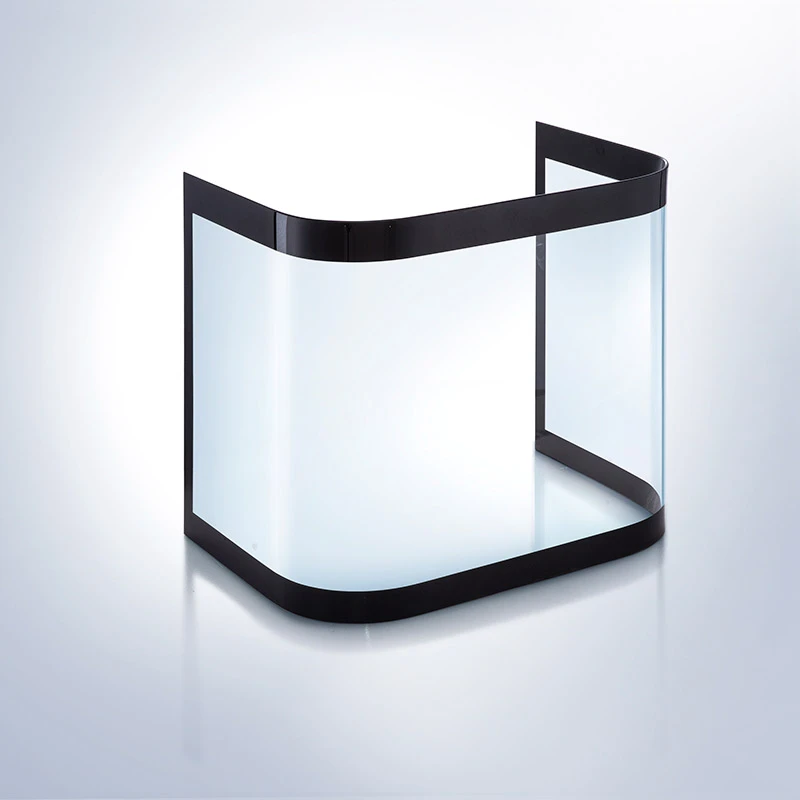
Indium tin oxide is a transparent semiconductor that conducts electricity while allowing most visible light to pass through. When deposited as a thin film (typically 100–300 nanometers) on glass by magnetron sputtering, ITO forms a resistive layer. Passing a low-voltage current across this layer generates heat through resistive dissipation, warming the glass surface above the dew point.
The two key electrical parameters are sheet resistance (measured in ohms per square, Ω/□) and power density (W/m²). Typical ITO coatings for anti-fog glass technology operate between 5 and 15 Ω/□, with power densities ranging from 250 W/m² to 800 W/m² depending on door size, climate zone, and target defogging speed.
A well-sputtered ITO film maintains visible-light transmittance above 80%. At Huayin, the coating process is tuned to keep haze below 1% and color shift (ΔE) within acceptable limits, so the heated pane does not distort product colors inside the cabinet.
Because the ITO layer is located on surface #2 or #3 of an insulated glass unit (IGU), it is protected from physical contact, moisture, and cleaning chemicals. Combined with tempered or heat-strengthened substrates, the coating can last the full service life of the door assembly.
An ITO-coated pane alone does not make a freezer defog glass door. It must be wired into the IGU and connected to a controller. The standard assembly includes:
Bus bars: Silver-paste strips screen-printed along two opposite edges of the ITO layer. They distribute current evenly across the full width of the pane.
Lead wires: Flexible stranded copper wires soldered or crimped to the bus bars, exiting through a small notch or groove in the spacer.
Controller: A thermostat or humidity sensor that switches the heater on only when needed. Advanced controllers use PWM (pulse-width modulation) to maintain surface temperature while minimizing energy use.
IGU sealing: The coated pane is combined with a Low-E outer pane, argon fill, and a warm-edge spacer to create an energy-efficient insulated glass assembly.
Huayin's manufacturing line performs 100% electrical continuity testing after bus-bar printing and again after final IGU assembly. This double-check eliminates field failures caused by hairline cracks in silver traces or poor solder joints.
| Dimension | ITO Heated Glass | Hydrophilic Coating |
|---|---|---|
| Defogging principle | Resistive heating raises glass surface above dew point | Reduces water contact angle so droplets spread into a transparent film |
| Heating uniformity | Excellent: entire coated area warms evenly | None: relies on ambient airflow |
| Response time | Fast: visible improvement in 30–120 seconds | Slow: depends on cabinet warm-up and humidity |
| Optical impact | Very low: transmittance ≥80%, haze ≤1% | Low when clean, but coatings can degrade or scratch |
| Energy use | Controllable via thermostat/PWM | No direct energy use, but ineffective in severe condensation |
| Best use case | Freezers, high-end cake/wine display cabinets | Low-cost ambient displays with mild humidity |
| Maintenance | Protected inside IGU, minimal maintenance | Outer surface coating may wear and require reapplication |
Large vertical freezer doors in supermarkets experience frequent opening cycles. ITO heating clears fog rapidly after each door event, maintaining merchandise visibility and reducing the time the compressor must recover lost cold air.
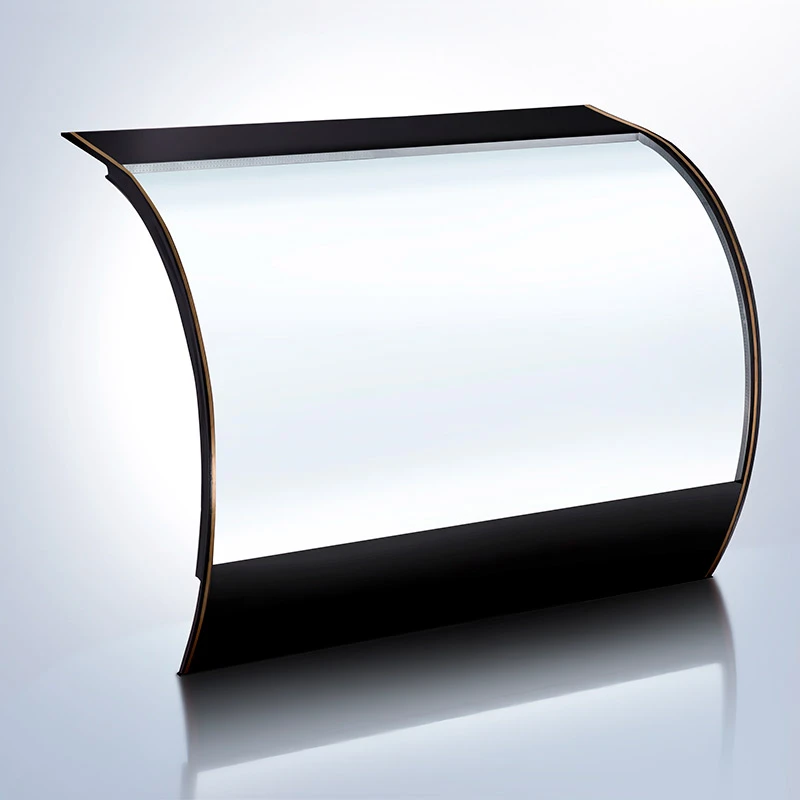
Cake cabinets operate at +4°C to +8°C with bright internal LED lighting. Fog is both a sales problem and a hygiene concern because beaded water can harbor bacteria on the gasket. Cake cabinet curved glass from Huayin can be bent, tempered, and then ITO-coated to match custom display designs.
Wine coolers often sit in climate-controlled rooms with stable humidity, but in tropical markets or seasonal peaks, condensation still occurs. Wine cooler glass with ITO coating preserves the premium appearance expected by high-end retailers.
Beyond food retail, ITO heated glass is used in medical refrigerators where internal inventory must be visible without opening the door, helping maintain temperature stability for vaccines and biological samples.
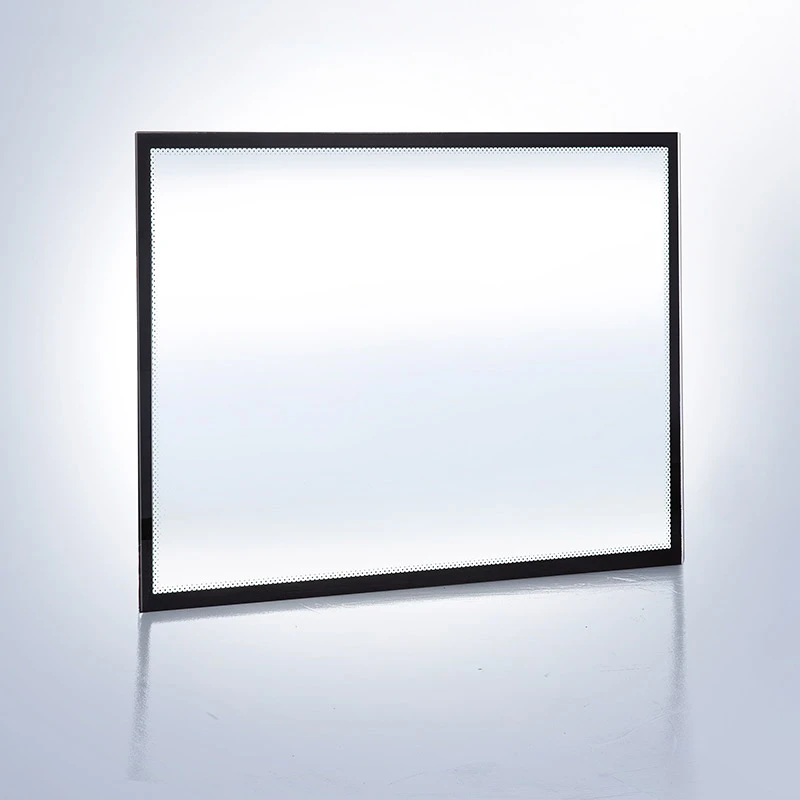
When sourcing ITO heated glass from a heated glass manufacturer China partner, buyers should verify both the glass processing capability and the electrical engineering discipline. Key questions include:
What is the typical sheet resistance range? A supplier should specify Ω/□ and explain how it maps to power density for your door size.
Can you provide transmittance and haze data? Request third-party optical reports to ensure the coating does not degrade display quality.
How is the bus bar applied and tested? Screen-printed silver paste followed by continuity and adhesion testing is the industry norm.
What controllers and sensors are offered? A complete supplier can integrate the heater with a thermostat, humidity sensor, or PWM controller.
What certifications do you hold? ISO 9001, product safety certifications, and export compliance documents such as ROHS and REACH are essential.
Can you support custom sizes and curved glass? If your product uses curved tempered glass, confirm the supplier can coat and bend without cracking the ITO film.
Huayin Glass Solutions, established in 2002 in Foshan, Guangdong, operates a 6,000+ m² facility with ISO 9001:2015 certification and exports to 50+ countries. The company offers OEM and ODM development for ITO heated glass, from prototype to mass production.
Q: How much power does ITO heated glass consume?
A: Typical power density is 250–800 W/m² depending on climate zone and door size. With a thermostat or PWM controller, average energy consumption is much lower than the rated maximum because the heater cycles on and off.
Q: Can ITO coating be applied to curved glass?
A: Yes, but the sequence matters. At Huayin, the ITO film is sputtered onto flat glass, which is then bent and tempered in a controlled thermal process that preserves the conductive layer. Very tight radii may require prototype validation.
Q: Does ITO heated glass interfere with LED lighting?
A: No. The coating is transparent and has no electromagnetic interaction with LED drivers. Huayin integrates LED strips into the door frame with the heater controller in a single wiring plan.
Q: What is the typical lead time for custom ITO heated glass?
A: Prototypes usually take 7–15 days, and mass production runs 25–40 days depending on order size and coating specifications. Early engineering review of the door drawing helps avoid rework.
ITO heated glass is the most effective defogging technology for commercial refrigeration because it heats the viewing pane uniformly, responds quickly, and remains protected inside the insulated glass unit. For buyers evaluating a heated glass manufacturer China partner, the decision should rest on optical performance data, electrical testing discipline, and the ability to integrate the heater into a complete refrigerator glass door assembly.
Huayin Glass Solutions combines ITO sputtering, tempered/curved glass processing, IGU assembly, and door accessory sourcing under one roof. If you are sourcing freezer defog glass for a new product line or retrofit program, contact us through our contact page for a technical review and quotation.
Further reading: ITO Glass vs Defogging Coating Comparison · Commercial Freezer Glass · Manufacturing Capability
Add:No. 16 Xingye Road, Beijiao Town Industrial Park, Shunde District, Foshan City, Guangdong Province
PHONE: +86 13509957538
TEL: +86 0757-26131933
Email: huayin_glass@163.com

© 2026 Huayin Glass Solutions All Rights Reserved.


