


 Add:No. 16 Xingye Road, Beijiao Town Industrial Park, Shunde District, Foshan City, Guangdong Province
 PHONE: +86 13509957538
 TEL: +86 0757-26131933
 Email: huayin_glass@163.com

Chinese


Specifying curved glass for a display cabinet, refrigerator door, or architectural façade often hits the same question from procurement teams: should we order hot bent glass or curved tempered glass? The two terms look interchangeable on a Chinese supplier's quotation — both involve heating flat glass and forming it over a curved mold — but they actually describe different process routes that produce very different mechanical, optical, and economic results. This guide walks engineers, product managers, and overseas buyers through what each process delivers, where each one fits, and how to evaluate a curved tempered glass manufacturer in China as a long-term OEM partner.
In the Chinese glass processing industry — and increasingly across Asian, European, and American supply chains — hot bent glass (热弯玻璃) refers to flat annealed glass that is heated to its softening point (~620 °C) and then slumped over a ceramic or metal mold to take a curved shape. It is then cooled slowly in an annealing lehr. The result is a curved glass sheet that is essentially annealed: it has not been through a quenching stage to induce surface compression.
Curved tempered glass (弯钢玻璃 / 曲面钢化玻璃), sometimes called thermally bent glass in Western catalogs, adds a critical second step: after the curved shape is formed, the glass is reheated to near-softening and then rapidly quenched with high-velocity air nozzles on both surfaces. This quench hardens the surface into a balanced compressive layer, producing the characteristic tempered-glass properties defined in EN 12150 and ASTM C1048.
Many commercial freezer door applications actually need the third hybrid step: curved tempered insulating glass — curved, tempered, then assembled into a double-glazed unit with Low-E coating, argon gas filling, and heated ITO film layers. We will return to this layered construction at the end.
The line consists of a heating furnace (electric or gas), a forming station with one upper and one lower mold (or a single-side mold + gravity sag), and a long annealing oven. Cycle time is slow — typically 1.5 to 4 hours per piece, depending on thickness and curvature depth. Because the glass stays soft for a long time, complex compound curves (j-curves, S-curves, asymmetric radii) are feasible.
The curved tempering line is a hot bent glass line with an additional quench chamber and a toughening-air blower array. After forming, the curved blank is shuttled into the quench, where dozens of air knives blow simultaneously from above and below. The challenge: the glass is now curved, so the air knives must maintain a constant stand-off distance from a non-flat surface. This is why curved tempering lines use flat-array nozzles plus a shaped air ring that follows the curvature.
A complete curved glass tempering furnace cycle is approximately 40–90 seconds per piece for thin (3–5 mm) freezer-door blanks and 90–180 seconds for thick architectural panels. This is one of two reasons why curved tempered glass costs more than hot bent glass.

Curved tempered glass develops a surface compressive layer of 69–120 MPa (per EN 12150-1), versus approximately 7–15 MPa in annealed or hot bent glass. When broken, curved tempered glass fragments into small, blunt, relatively harmless granules — the same safe fracture pattern as flat tempered glass. Hot bent glass, in contrast, breaks into long sharp shards similar to annealed flat glass.
In most jurisdictions, any single-pane architectural glazing within reach of building occupants — including sloped overhead glazing, balustrades below 1 m, and public-area doors — must be safety glass. Curved tempered glass is the default choice for these applications because it already meets EN 12150 / ANSI Z97.1. Hot bent glass would need to be laminated or combined with a security film to meet the same code. For commercial appliances such as refrigerator glass door panels where end users can touch the glass, curved tempered is similarly preferred.
This is the single biggest visual downside of curved tempered glass. During quench cooling, the rapid surface hardening creates localized stress patterns that show up as faint colored streaks or "leopard spots" when viewed at an angle under polarized light. Most owners tolerate the effect because strength benefits outweigh aesthetics, but for premium display cabinets where viewing angle is critical, this is worth discussing with the supplier up front.
Hot bent glass has no anisotropy because there is no quench stage. When optics is the priority — for example, jewelry display, museum-grade pastry cabinets, or high-end wine chillers — hot bent glass is usually the better answer.
Hot bent glass, with its slow forming cycle, can be slumped into very precise compound shapes — oval displays, asymmetric arches, and tight S-curves. Curved tempered glass is limited to simpler geometries because the quench must be uniform. If your design needs a complex compound curve, hot bending is essentially your only choice; laminated tempered pieces are possible but expensive.
The practical forming envelope differs significantly between the two processes. Numbers below are typical for a mid-volume China curved glass OEM factory producing 3–8 mm float or low-iron glass.
| Parameter | Hot Bent Glass | Curved Tempered Glass |
|---|---|---|
| Minimum bending radius (3 mm) | R 100 mm | R 200 mm (special tool R 150) |
| Maximum size (single piece) | 2,400 × 4,200 mm | 2,400 × 4,200 mm |
| Thickness range | 3 – 19 mm | 3 – 12 mm |
| Compound / S-curves | Yes (with 3-axis mold) | No (single-radius only) |
| Spontaneous break rate | ~0 % (no NiS risk) | ≤ 0.3 % (NiS possible) |
The shape envelope makes hot bent glass the only option for showpieces like the curved glass doors of pastry display cabinets with non-circular profiles, and curved tempered glass the workhorse for mass-produced commercial supermarket freezer doors.
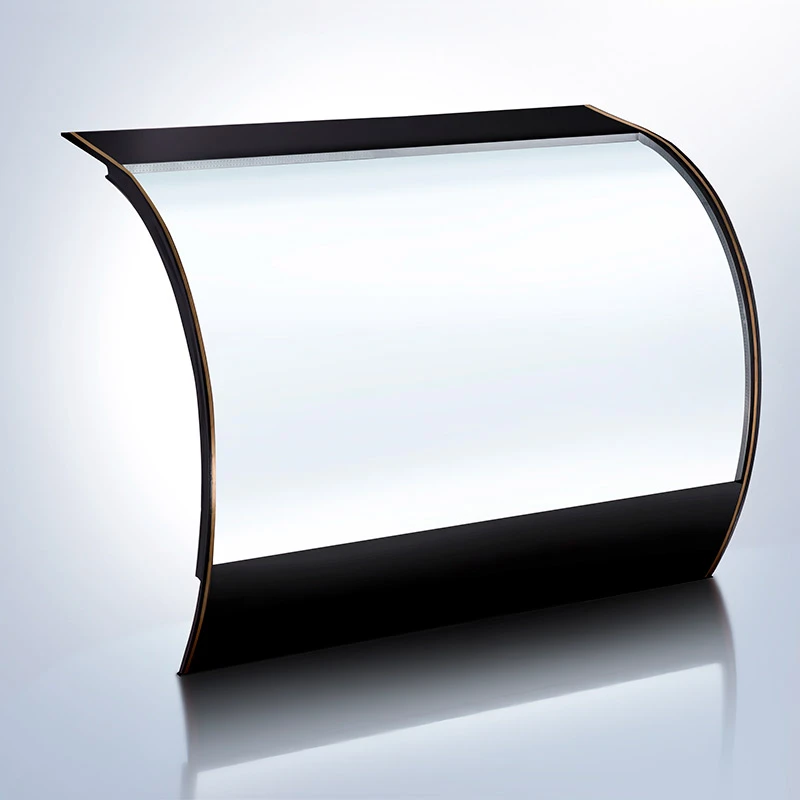
Cost drivers look similar on paper (raw glass + energy + labor), but break down very differently at the line level.
Both processes require a forming mold (often made of welded steel with a ceramic fiber facing). For hot bent glass the mold is usually the dominant tool cost; for curved tempered, the mold is similar but the line capex is far higher because the quench section itself costs several hundred thousand USD. This is why curved tempered lines cluster at large China glass deep-processing factories.
Hot bent glass uses roughly 1.5×–2.5× more energy per piece due to its long heating/annealing cycle. Curved tempered glass uses more energy per minute but the cycle is short, so per-piece energy is comparable. Labor is similar. Net unit-cost difference: curved tempered is typically 15 %–35 % more expensive than hot bent, depending on geometry and volume.
Hot bent: mold 10–15 days, sample 3–5 days, batch 7–10 days. Curved tempered: mold 10–15 days, sample 3–5 days, batch 5–7 days (because cycle is faster). For OEMs serving displays with stable geometry, both are achievable inside 25 days from drawing to first article.
Pastry and cake display cabinets with non-circular curved fronts.
High-end wine chillers where low anisotropy is critical.
Showcase and museum cabinets where visual perfection outweighs safety code.
Architectural skylights and curved partitions finished with laminated safety film.
Commercial freezer and refrigerator doors.
Self-service glass door merchandisers.
Building balustrades and elevator lobbies.
Curved shower enclosures and balustrade infill panels.
For energy-efficient refrigerators and freezers, the panel is usually a curved tempered coated heated IG sandwich: curved-tempered outer lite, insulating spacer filled with argon, heated ITO-coated inner lite, optional Low-E coating. This is the most common construction in today's commercial supermarket freezer racks.
Choosing between hot bent and curved tempered is half the battle. Picking a curved glass OEM partner in China that delivers consistent quality is the other half. Here is the criteria Huayin Glass Solutions uses to qualify itself in customer audits.
Raw glass purchase → cutting → edging → cleaning → heating → forming → quenching (for tempered) → insulating glass assembly → QC. Multi-vendor supply chains create defects at every interface; vertical integration collapses that risk.
Inspect the air-knife array on the tempering line. The nozzles should be independently adjustable so that zones with more curvature receive different air pressure — without this, the convex side cools faster than the concave side, producing warp.
An experienced China curved tempered glass factory maintains a library of standard radius molds (R 200, R 300, R 500, R 1000, R 1500, R 2000 mm) and can complete new custom molds within 10–15 days. Ask whether the supplier charges mold fees or amortizes them across the order volume.
Each batch should ship with: fragment-pattern test (per EN 12150), surface compression test, dimensional report, and optical-quality polarizer photos. SGS / TÜV / Intertek third-party reports are recommended for export.
The process decision — hot bent versus curved tempered — should happen before you choose a supplier. If your project values safety and throughput, curved tempered is the default. If it values optical clarity and complex shape, hot bent is the default. If it values both — premium safety plus high clarity — then you are entering the territory of curved tempered coated heated insulating glass, which is what most modern refrigerator and freezer projects ultimately need.
Whichever route you take, partner with a vertically integrated curved glass manufacturer that can run both lines and assemble insulating glass units under one roof. Reach out for engineering samples and a quotation at the Huayin Glass Solutions contact page.
Further reading: Curved Tempered Glass · Hot Bending Glass · Curved Tempered Coated Heated IG Glass · Hot Bent Laminated Glass · Commercial Supermarket Freezer Glass · ITO Glass vs Defogging Coating Comparison
Add:No. 16 Xingye Road, Beijiao Town Industrial Park, Shunde District, Foshan City, Guangdong Province
PHONE: +86 13509957538
TEL: +86 0757-26131933
Email: huayin_glass@163.com

© 2026 Huayin Glass Solutions All Rights Reserved.


