


 Add:No. 16 Xingye Road, Beijiao Town Industrial Park, Shunde District, Foshan City, Guangdong Province
 PHONE: +86 13509957538
 TEL: +86 0757-26131933
 Email: huayin_glass@163.com

Chinese


The glass tempering process is the backbone of modern safety glass manufacturing. Whether you are sourcing freezer glass doors, home appliance panels, or curved display cabinet glass, understanding how tempered glass is made — and which safety standards it must meet — is essential for procurement teams evaluating a curved tempered glass manufacturer in China. This technical guide walks through the heating, quenching, and quality control stages of tempering, compares flat and curved tempering methods, and explains the international safety standards that govern tempered glass performance.
Tempered glass — also called toughened glass — is annealed glass that has been heated to near its softening point and then rapidly cooled. This process creates a compressive stress layer on the glass surfaces and a tensile stress zone in the core. The result is a product that is 4 to 5 times stronger than ordinary annealed glass of the same thickness, and which breaks into small, granular chunks rather than sharp, jagged shards.
For commercial refrigeration, food display cabinets, and home appliance panels, this combination of strength and safe-break behavior is not optional — it is a legal requirement in most markets. That is why every reputable tempered glass supplier must be able to certify compliance with recognized safety standards. Huayin Glass Solutions operates forced-convection flat and curved tempering furnaces to produce certified tempered glass for refrigerator glass doors, home appliance glass panels, and curved tempered glass products.
The tempering process begins by heating annealed glass in a tempering furnace to approximately 620–680°C (1,148–1,256°F) — just below the glass softening point. The glass must reach this temperature uniformly across its entire surface and thickness. Any temperature gradient — hotter at the center, cooler at the edges — will produce uneven stress and increase the risk of spontaneous breakage later.
Modern tempering furnaces use forced convection — hot air jets circulating inside the heating chamber — to ensure uniform temperature distribution. This is especially important for Low-E coated glass, where the reflective coating can block radiant heat and cause uneven heating if the furnace relies on infrared radiation alone. Huayin's forced-convection furnaces can temper Low-E coated glass without stripping the coating, which is critical for producing energy-efficient commercial supermarket freezer glass.
Heating time scales with glass thickness. As a rule of thumb, the furnace needs approximately 40–50 seconds per millimeter of thickness. A 6mm glass panel requires about 4–5 minutes in the heating chamber; a 12mm panel needs 8–10 minutes. Underheating leaves the glass insufficiently softened and produces weak tempering; overheating causes the glass to sag on the roller bed, creating optical distortion known as "roller wave."

Once the glass reaches the target temperature, it is transferred rapidly to the quenching section, where high-pressure air jets blast both surfaces simultaneously. The outer surfaces cool and contract first, while the inner core remains hot and plastic. As the core eventually cools and contracts, it pulls on the already-solidified surfaces, locking them into permanent compressive stress.
The surface compressive stress of fully tempered glass typically reaches 90 MPa or higher — this is the figure cited in safety standards like EN 12150. The tensile stress in the core is lower (typically 30–40 MPa) but still significant. This stress differential is what gives tempered glass its strength: the compressive layer on the surface resists bending and impact forces.
The speed of quenching determines the break pattern. Faster quenching produces smaller particles; slower quenching produces larger fragments. Safety standards specify maximum particle counts within a defined area — if the particles are too large, the glass fails certification. A properly quenched pane of tempered glass breaks into hundreds of small, blunt-edged granules rather than a few large sharp pieces.
The two main tempering formats — flat and curved — use different furnace configurations and serve different applications. Understanding the distinction helps buyers specify the right product.
| Dimension | Flat Tempering | Curved Tempering |
|---|---|---|
| Furnace type | Flat roller hearth furnace | Curved roller or sectional bending furnace |
| Product shape | Flat panels | Cylindrical, spherical, multi-curvature |
| Typical applications | Appliance panels, flat door glass | Curved freezer doors, cake cabinet glass, wine cooler doors |
| Minimum bend radius | N/A | Depends on furnace and glass thickness |
| Key challenge | Roller wave distortion control | Curvature precision and optical quality |
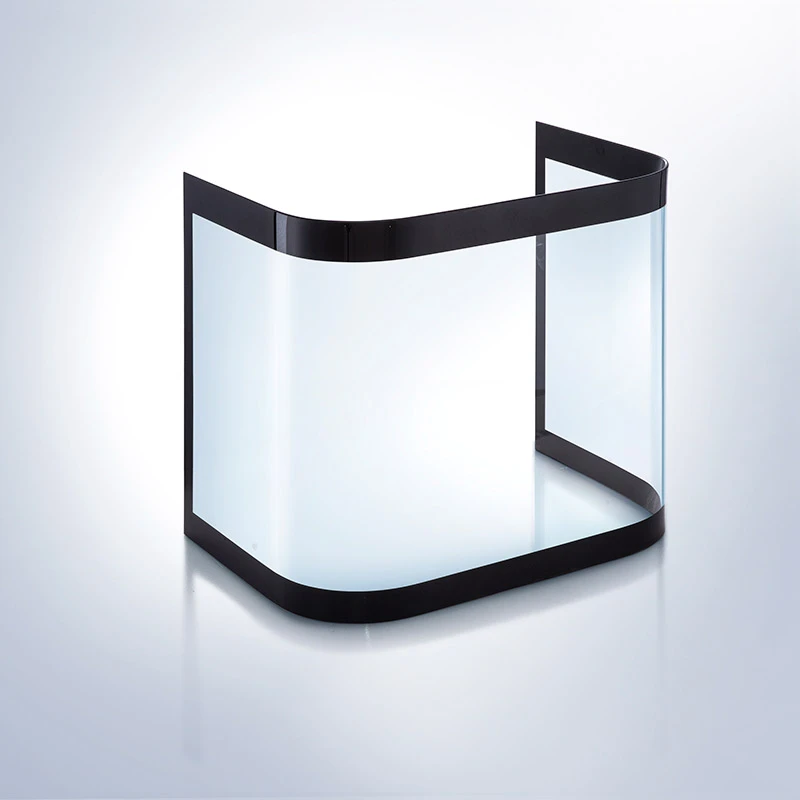
For buyers sourcing curved glass for display cabinets, it is important to verify that the factory has dedicated curved tempering equipment — not all tempered glass factories in China can produce multi-curvature glass. Huayin's curved tempering capability covers curved tempered glass, coated curved tempered anti-fog glass, and hot-bent insulated heating glass.
Tempered glass is a regulated safety product. Buyers should require certification to at least one of the following standards, depending on the destination market:
EN 12150 is the European standard for thermally toughened soda-lime silicate safety glass. It specifies the minimum surface compressive stress (≥90 MPa), the maximum particle count in a 50mm × 50mm area after breakage (typically 40–400 particles depending on thickness), and tolerance requirements for dimensions, edge flatness, and bow. CE marking for architectural and appliance glass in the EU requires EN 12150 compliance.
ANSI Z97.1 is the American National Standard for safety glazing materials. It defines impact test requirements — a 100 lb leather bag filled with lead shot is dropped from specified heights onto the glass — and classifies glass as Category I or Category II based on impact resistance performance. CPSC 16 CFR 1201 is the related consumer safety regulation, which ANSI Z97.1 is often tested alongside.
For the Chinese domestic market, tempered glass for building and appliance use requires China Compulsory Certification (CCC / 3C). The 3C mark confirms the product meets GB 15763.2 (safety glass standard). Huayin's tempered glass products carry 3C certification alongside ISO 9001:2015 quality management certification. Learn more about our certifications on the About Us page.
Even with the right furnace and standards, batch-to-batch quality consistency depends on the factory's QC discipline. Here are the key checks a China tempered glass manufacturer should perform on every order:
Toughened glass can spontaneously break if it contains nickel sulfide (NiS) inclusions — microscopic impurities that expand slowly over time. The heat-soak test (EN 14179) accelerates this expansion by holding the glass at 290°C for several hours; any pane with NiS will break during the test. While not always mandatory, heat-soaked tempered glass is recommended for high-risk applications.
A surface stress meter uses polarized light to verify the compressive stress level. This non-destructive test confirms the glass has reached full tempering — stress below 90 MPa means it is technically only heat-strengthened, not fully tempered.
A sample pane is deliberately broken, and particle count and size within a 50mm × 50mm reference area are measured against the standard. This test verifies safe-break behavior. See our manufacturing capabilities page for QC process details.
For flat tempering, roller wave distortion (a periodic wave pattern from the furnace rollers) must be controlled within tolerance — typically ≤0.3mm per 300mm for appliance-grade glass. For curved tempering, curvature deviation from the target radius must be checked with templates or laser scanning.
Q: What is the minimum thickness for tempered glass?
A: Most tempering furnaces can handle glass from 3mm to 19mm thick. Below 3mm, the glass is too thin for reliable quenching; above 19mm, heating time becomes very long and distortion risk increases. For freezer door applications, 5mm or 6mm is the most common thickness. See our product catalog for available specifications.
Q: Can tempered glass be cut or drilled after tempering?
A: No. Tempered glass cannot be cut, drilled, or edged after the tempering process — any cutting attempt will cause the entire pane to shatter. All holes, edge shapes, and cutouts must be completed before tempering. This is why buyers must finalize drawings before production begins.
Q: What is the difference between heat-strengthened and fully tempered glass?
A: Heat-strengthened glass has a surface compressive stress of 24–69 MPa (below the 90 MPa threshold for full tempering). It is roughly 2 times stronger than annealed glass and breaks into larger pieces. Fully tempered glass is 4–5 times stronger and breaks into small granular pieces. Freezer and appliance applications almost always require fully tempered glass.
Q: Does curved tempered glass cost more than flat?
A: Yes, typically 30–60% more, due to slower production speed, higher breakage risk during bending, and the need for specialized curved tempering equipment. For an in-depth comparison, see our technical article on ITO glass vs defogging coating.
Understanding the glass tempering process — from the 620°C heating window through forced-convection quenching to the 90 MPa compressive stress that defines safety glass — empowers procurement teams to ask the right questions when evaluating suppliers. Whether your project requires flat tempered panels for appliance control boards or multi-curvature curved tempered glass from a China manufacturer, insist on EN 12150 or ANSI Z97.1 certification, verify heat-soak and fragmentation test records, and confirm the factory has both flat and curved tempering capabilities if you need both product types.
Huayin Glass Solutions operates forced-convection flat and curved tempering furnaces at its 6,000+ sqm facility in Foshan, Guangdong, with 25 years of deep-processing experience and ISO 9001:2015 / 3C certification. Contact us to discuss your tempered glass requirements: https://www.huayinglass.com/contact/
Further reading: Freezer Glass Solutions · Induction Cooker Glass Panels · Curved Tempered Glass · Client Projects
Add:No. 16 Xingye Road, Beijiao Town Industrial Park, Shunde District, Foshan City, Guangdong Province
PHONE: +86 13509957538
TEL: +86 0757-26131933
Email: huayin_glass@163.com

© 2026 Huayin Glass Solutions All Rights Reserved.


