


 Add:No. 16 Xingye Road, Beijiao Town Industrial Park, Shunde District, Foshan City, Guangdong Province
 PHONE: +86 13509957538
 TEL: +86 0757-26131933
 Email: huayin_glass@163.com

Chinese


Screen-printed tempered glass is a tempered glass panel carrying a ceramic frit pattern — typically a brand logo, decorative band, or opacity mask — fired into the surface during the tempering cycle. It is applied to freezer LOGO doors where the glass itself must carry the brand identity permanently, surviving wiping, condensation, cleaning chemicals and years of commercial use. This guide covers the ink system, firing sequence, durability tests, and the specification items that separate a print that lasts from one that fails in the field.
Ceramic frit ink is a glass-pigment suspension: finely ground glass particles carrying inorganic pigments, mixed with a temporary medium that burns off during firing. After the tempering cycle the frit is fused into the glass surface — it is no longer a coating but part of the glass itself.
Freezer doors are wiped daily, exposed to condensate, and cleaned with commercial agents. Organic inks and applied films sit on the surface and erode under exactly these conditions. Frit, once fired, has the chemical durability of glass. This is the same reason fired ITO films outlast applied defogging coatings: anything fused into the surface outlives anything laid on it.
Inorganic pigments cover a strong but not unlimited color gamut. Reds and oranges are achievable but color matching against brand references must be done with fired samples, not wet-ink swatches — the pigment shifts slightly during firing. White is used both as a design color and as an underlay beneath brand colors on LED-lit doors.
The print is applied to cut, edged glass, then the panel enters the tempering furnace. Frit sinters and bonds at tempering temperature — roughly 620-700°C for the glass surface — so printing and firing happen in one thermal cycle.
This sequence means three practical rules. First, all mechanical work — cutting, notching, hole drilling — must be finished before printing, because post-tempering machining would shatter the glass. Second, the printed face must face the furnace correctly to avoid roller marks through fine patterns. Third, reprints are impossible: a defective print means a new pane, which is why first-article approval matters so much in custom LOGO glass door programs.
Beyond logos, an opaque frit band is often printed along the door perimeter to mask internal cabinet structure and improve contrast for shelving. The band doubles as UV protection for the cabinet interior — a frequent requirement in food display applications.
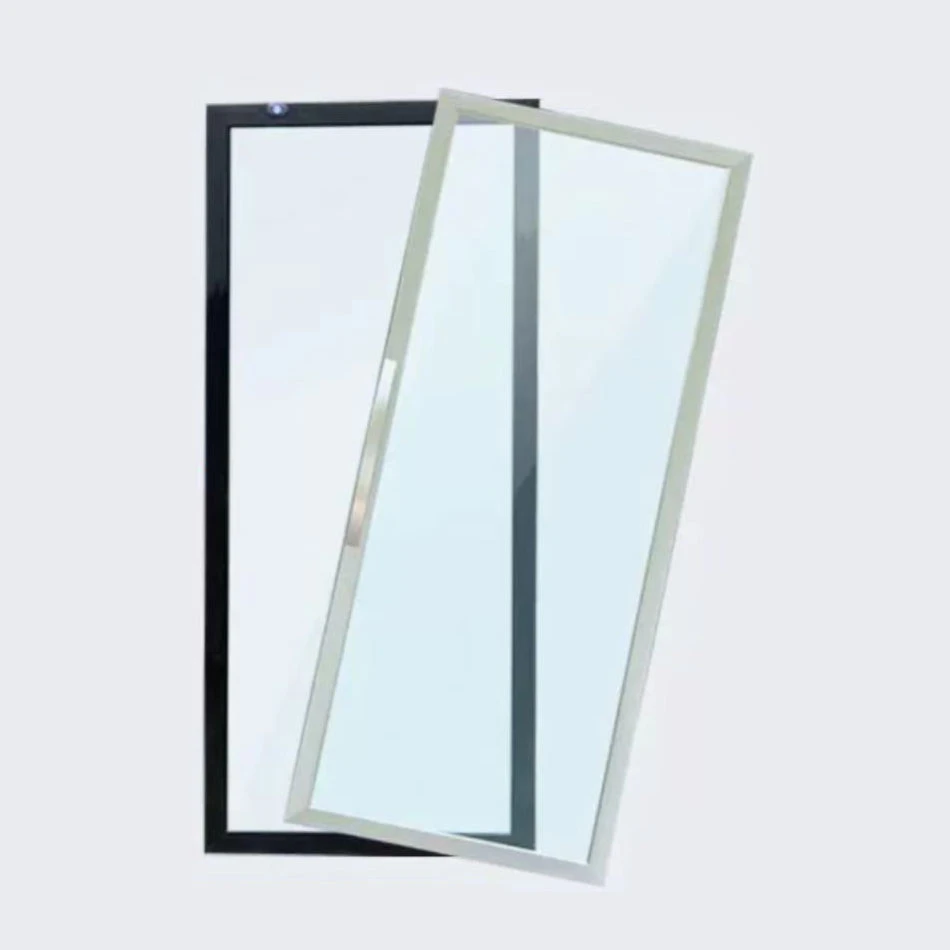
Four parameters define print quality on production panels. Each belongs in the purchase specification, not just in a supplier's internal standard.
| Parameter | Typical requirement | Failure mode if uncontrolled |
|---|---|---|
| Registration | ±0.5mm against approved artwork | Logo offset from lamp channel or handle cutouts |
| Color tolerance | ΔE ≤ 1.5 against fired master sample (D65) | Brand color drift between batches |
| Edge definition | No feathering under 10x magnification | Fuzzy logo edges under display lighting |
| Pinholes and voids | None visible in brand-critical area | Light bleed through logo in LED-lit doors |
Fired frit is inherently durable; testing exists to catch process defects, not to simulate decades of use. Three tests cover the field-relevant risks.
A standard cross-hatch with tape pull confirms the frit bonded to the substrate. Failures indicate under-firing — the single most common process defect when a furnace runs near capacity.
Wiping with representative cleaning agents (ammonia-based glass cleaner, mild acid) confirms no attack on the fired surface. Frit passes by design; failures trace to unfired residue or an organic overprint.
Cycling between freezer and ambient conditions checks for micro-cracking at the frit-glass boundary, relevant where the printed face sits on the warm exterior of an insulated door.
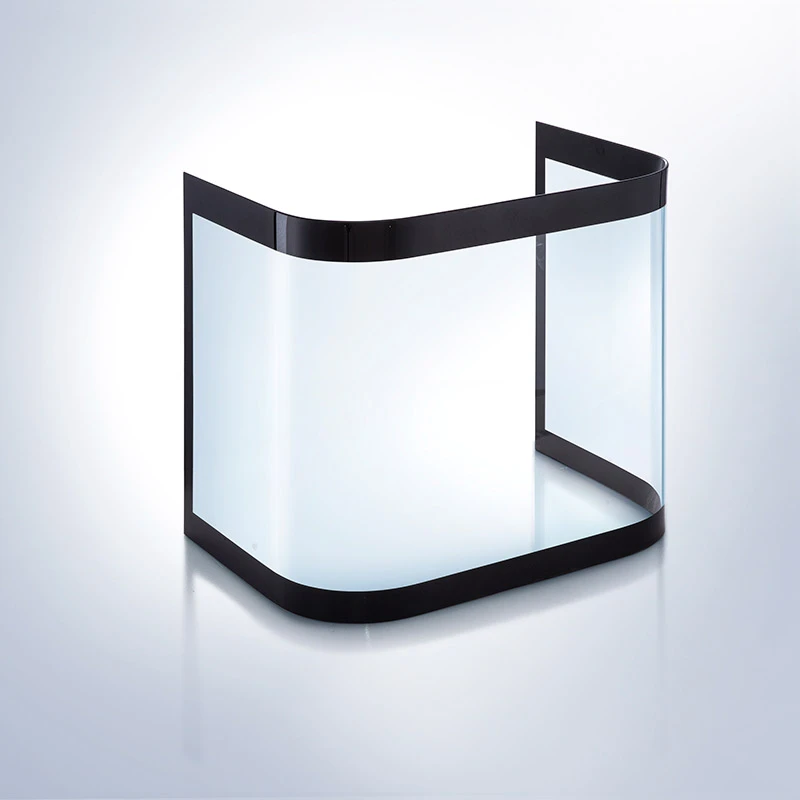
Printed panes combine freely with other freezer glass technologies, but the process order is fixed: print and temper first, then assemble.
For doors needing both a logo and defog heating, the print is fired during tempering of the coated pane. Busbar and terminal positions must be specified before printing, because no post-tempering adjustment is possible.
In a double-glazed door, the print typically sits on the inner surface of the outer pane, sealed inside the cavity — protected from the venue side entirely. This placement also keeps the outer surface fully flush for gasket sealing.
Supplying vector artwork and the pane configuration is usually enough for an engineering team to return a printable layout proof within days. The most common inquiry gap is color specified only from a screen rendering — always insist on a fired sample for color sign-off.
| Term | Definition |
|---|---|
| Ceramic frit | Glass-pigment ink fired into the glass surface, becoming part of the glass |
| Registration | Positional accuracy of the printed pattern against the approved artwork |
| ΔE | Numeric measure of color difference; used for batch color tolerance |
| Underlay | White frit layer printed beneath brand colors to preserve saturation under lighting |
| Mask band | Opaque printed band used to hide cabinet internals and block UV |
| First article | The initial production panel inspected and approved before batch release |
Q: Can printing be applied to curved glass doors?
A: Yes. The print is applied before hot bending and tempering, and screen tooling must account for pattern distortion across the curve. Curved printed panels should be evaluated at sample stage, where distortion compensation is tuned.
Q: How many colors can one door carry?
A: Practical single-pass setups handle one to three colors; more colors mean additional screen passes with registration risk. Complex multi-color brands are usually engineered with an underlay plus a limited spot palette.
Huayin Glass Solutions operates in-house screen printing alongside tempering and insulated glass assembly in its 6,000+ square meter Foshan facility, supplying printed doors together with freezer glass product lines. Process capability is summarized at our manufacturing page.
Send your logo artwork and door dimensions for a printability assessment and fired sample: contact our engineering team.
Further reading: Rounded-corner screen-print door · Branded beer cooler glass door · Client cases
Add:No. 16 Xingye Road, Beijiao Town Industrial Park, Shunde District, Foshan City, Guangdong Province
PHONE: +86 13509957538
TEL: +86 0757-26131933
Email: huayin_glass@163.com

© 2026 Huayin Glass Solutions All Rights Reserved.


