

 Add:No. 16 Xingye Road, Beijiao Town Industrial Park, Shunde District, Foshan City, Guangdong Province
 PHONE: +86 13509957538
 TEL: +86 0757-26131933
 Email: huayin_glass@163.com

Chinese


A transparent display glass door turns a standard commercial freezer into a smart retail terminal: promotional content plays on the glass while products stay visible behind it. For beverage brands and convenience retail chains, the door is no longer a passive panel — it is the screen, the sensor platform and the brand surface at once. Sourcing this product from a China manufacturer is attractive on cost, but the failure modes are specific: delaminated display film, fogged panes that hide both products and content, and wiring that fails in refrigerated, high-humidity service. This guide walks OEM buyers through structure options, specifications, manufacturing requirements and factory verification, based on how these doors are actually produced.
Three deployment patterns dominate. First, smart freezers in convenience stores, where the glass plays advertising when the customer approaches and goes transparent when they reach for a drink. Second, beverage cooler doors in chain retail, where brands lease door space for on-glass campaigns and pay for measurable impressions. Third, promotional display cabinets for new product launches, where the door carries animated content without blocking product visibility.
In all three cases the door combines a transparent display glass door assembly with door-open sensing, playback control and often weight-sensing shelves underneath. The glass itself must stay optically clean at freezer-cabinet temperatures, which is why the glazing specification matters as much as the display electronics.
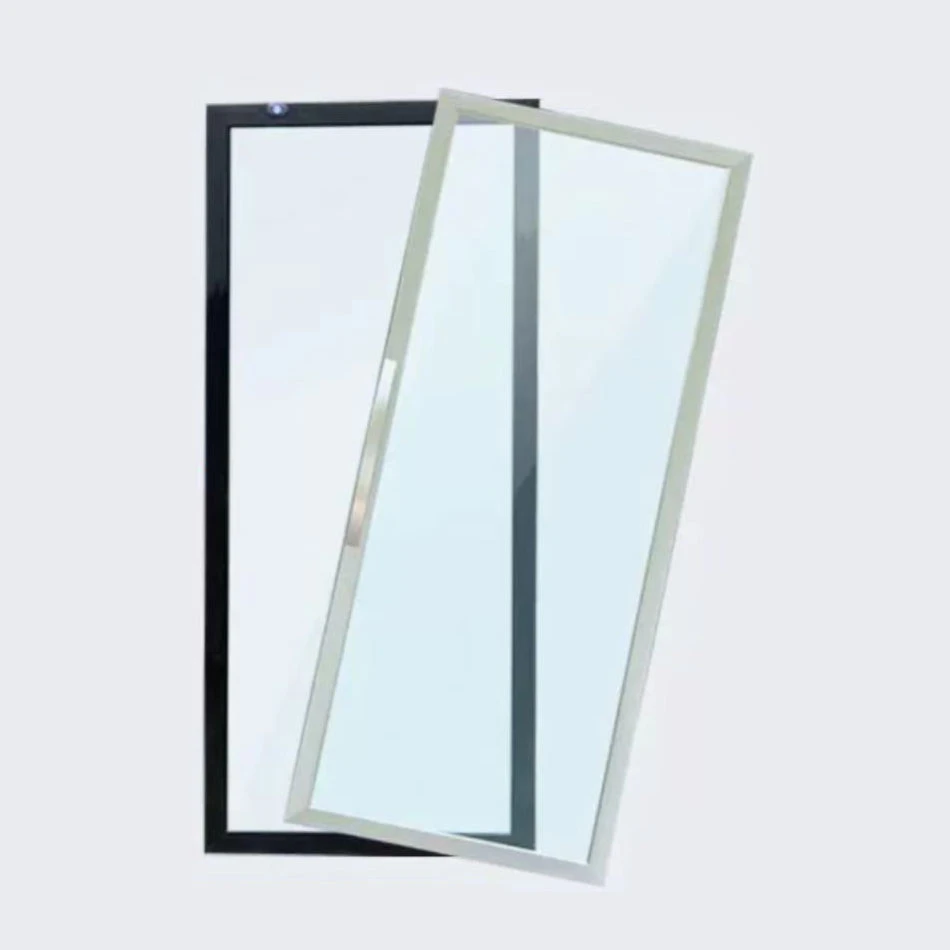
A production door is a stack, and each layer has sourcing consequences. The outer pane is tempered glass, typically 4-6 mm. The transparent display film is laminated between panes or onto the inner surface, with its active area cut to the visible window. The inner pane completes the build — as single glazing for mild applications or as an insulated unit with desiccant and argon fill for freezer duty.
Wiring is where prototypes fail. The film's driver board and the door's other electronics — LED light strips, door-open sensors, optional heated-glass busbars — need a routed channel through the frame with connectors that survive thousands of open-close cycles. Condensation management is the third pillar: at freezer temperatures, unheated glass fogs over and hides both product and content, so many smart doors pair the display layer with ITO heated glass or a coated anti-fog surface.
Display doors are customized per cabinet model, so a usable RFQ fixes the variables that drive both price and lead time. The table below lists the six specification blocks a manufacturer needs before it can return a meaningful quotation.
| Specification | What to define |
|---|---|
| Door geometry | Width, height, thickness, radius if curved; frame type and hinge positions |
| Display film | Film type, active window size and position, driver board location, content source interface |
| Glazing build | Single pane versus insulated unit; pane thickness; argon fill; Low-E option |
| Anti-fog strategy | ITO heated glass with power density, or coated anti-fog pane, per humidity profile |
| Wiring and control | Routing channel, connector standard, connector cycle rating, cable exit position |
| Compliance | CCC for China, CE for Europe, SGCC/ANSI for North America, plus destination-market glass standards |
Buyers who send only a door outline usually receive a quote for plain glass — the film, wiring and heating decisions are what move cost, and they must be fixed early.
The production sequence constrains which factories can build this product. Tempering happens first, because laminating a display film onto a pre-tempered pane then re-heating it would destroy both the film and the glass stress pattern. Film lamination follows in a controlled clean environment — dust trapped under a transparent film is permanently visible under cabinet lighting. Final assembly integrates the frame, gasket, hinges, wiring harness and lighting, followed by a 100% function test of film playback, sensors and any heating circuit.
This is why glass deep-processing factories with in-house tempering, lamination and assembly — rather than film integrators who buy glass on the open market — control the quality of the finished door end to end. Facilities that also produce custom LOGO glass doors and ambient-lighting glass doors run the same door platform daily, which shortens development for display variants.
Factory claims are cheap; process records are not. Before committing a smart-door program, verify five things — each checkable in a single video audit or sample shipment.
| Verify | How |
|---|---|
| Own tempering and lamination capability | Live video of tempering furnace and lamination area, equipment nameplates visible |
| Function test discipline | Request test records per batch: film playback, sensor, heating circuit continuity |
| Condensation engineering | Sample door tested at your humidity profile, not just a showroom demo |
| Certificates validity | CCC/CE/SGCC certificate numbers checked against issuing-body databases |
| Comparable projects | References for heated or display doors shipped to regulated markets |
A supplier that manufactures touch-control glass doors and heated insulated doors in volume has already solved most integration problems a display door will raise.
Typical program timelines run 10-15 working days for sampling (glass, film lamination and harness) and 30-45 days for mass production after approval, depending on film supply. MOQ is driven by the cabinet model rather than the glass: a single door model at a few hundred units per batch is realistic. For export, doors ship in plywood crates with corner protection, film-surface protection and separate electronics boxes; connectors and harnesses are packed to survive container vibration. Confirm the packing drawing before the first shipment — display film is far less tolerant of edge pressure than plain glass.
Q:Can a transparent display film be combined with ITO heated glass?
A:Yes, and in freezer-duty applications it usually should be. The heating layer sits on the outer pane while the film is laminated inside, with an isolation design so the heating circuit does not interfere with the display driver. Confirm both circuits at the sampling stage.
Q:What files should I send to start a quotation?
A:Door drawing with tolerances, film active-window dimensions, wiring diagram with connector types, glazing build, and the humidity/temperature profile of the target cabinet. With these, a manufacturer can return a DFM assessment within days.
Q:Do you supply complete door assemblies or glass only?
A:Both. Huayin Glass Solutions supplies glass panes, insulated units and complete door assemblies with frames, gaskets, hinges and lighting — see the refrigerator glass door range for platform options.
A transparent display glass door succeeds or fails on integration: glass that stays clear, film that stays bonded, wiring that survives the door's lifetime. Treat the door as a system, fix the six specification blocks early, and verify the factory's tempering, lamination and test discipline before committing. Huayin Glass Solutions has produced custom commercial freezer glass doors in Foshan since 2002, with in-house ITO heating, insulated glass assembly and a manufacturing chain described on our manufacturing capability page.
Ready to specify a smart freezer door? Send your drawings and humidity profile to our engineering team via the contact page for a free DFM assessment and sample quotation.
Further reading: ITO glass vs defogging coating · Client cases · Featured projects · Commercial supermarket freezer glass
Add:No. 16 Xingye Road, Beijiao Town Industrial Park, Shunde District, Foshan City, Guangdong Province
PHONE: +86 13509957538
TEL: +86 0757-26131933
Email: huayin_glass@163.com

© 2026 Huayin Glass Solutions All Rights Reserved.


