


 Add:No. 16 Xingye Road, Beijiao Town Industrial Park, Shunde District, Foshan City, Guangdong Province
 PHONE: +86 13509957538
 TEL: +86 0757-26131933
 Email: huayin_glass@163.com

Chinese


A North American kitchen-appliance brand faced a design problem that shows up on every premium appliance line eventually: mechanical buttons had to go. Their mid-range built-in wine cooler looked dated next to competitors running sleek glass fronts with invisible controls — but a touch control glass door is a system, not a swap. Sensing has to work through glass, the glass has to stay clear in a humid cellar environment, and the electronics have to survive thousands of door cycles. This case study follows the full OEM program: brief, requirements, engineering, validation and ramp-up to 3,000 doors in six months.
The brand's constraints were typical of appliance OEM work. The existing cabinet platform had to stay — same hinge positions, same cabinet cutout, same main control board interface. That turned the project from a cabinet redesign into a door-level engineering program, which is exactly where a glass manufacturer with in-house electronics integration earns its place.
The old control panel sat behind a plastic bezel on the glass door frame: three mechanical buttons, a segmented display, visible fasteners. Consumer testing told the brand what showroom feedback already suggested — buyers touched the glass expecting it to respond, and the buttons read as a lower product tier.
The brief was therefore precise: capacitive touch zones on the glass itself, no visible bezel, an ambient LED halo around the door perimeter, and zero change to the cabinet or the main board connector. The brand had shortlisted two suppliers and asked both for a working sample door on the existing platform within eight weeks.
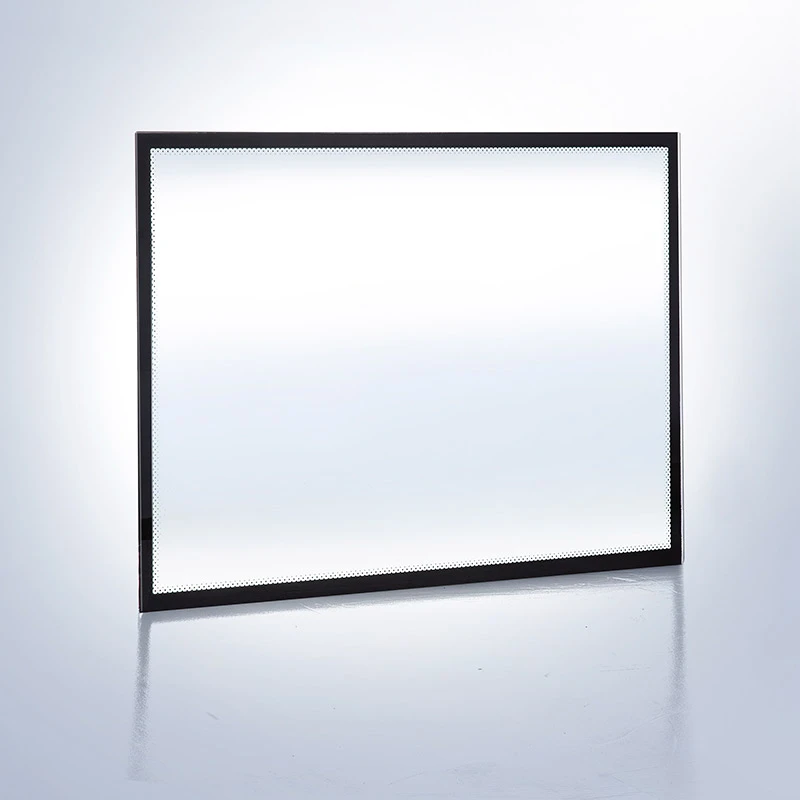
Converting the brief into a specification produced six requirement blocks, each tied to a verification method before anything entered mass production.
| Requirement | Target | Verification |
|---|---|---|
| Touch function | 3 capacitive zones through the glass, bezel-free | Activation test through full glass build |
| Glass construction | Tempered insulated unit matching existing frame | Dimensional fit on reference cabinet |
| Lighting | Ambient LED perimeter, uniform, dimmable | Photometric check against brand standard |
| Condensation | No visible fog at cellar humidity range | Climate chamber test at defined RH |
| Interface | Existing main-board connector, unchanged | Plug-in communication test |
| Durability | Touch and door cycles rated for appliance life | 10,000-cycle bench test |
The sensor PCB mounts behind the inner pane, and sensitivity is calibrated against the actual glass stack — pane thickness, coating layer and air gap all shift the capacitance baseline. The calibration is done per production build, not per product family, which is the difference between touch zones that feel identical across a production run and ones that drift.
Both panes were tempered to appliance safety standards and assembled as an insulated unit with desiccant and argon fill on the company's automated line. Because the factory produces wine cooler cabinet glass daily, the frame, gasket channel and hinge holes were produced to the existing platform drawing with no retooling.
The ambient LED halo uses side-lit light guides along the door perimeter — the same lighting architecture used in the company's ambient-lighting glass doors. Touch, lighting and door-open sensor wiring exit through a single harness to the unchanged main-board connector, with the routing channel machined into the frame profile.
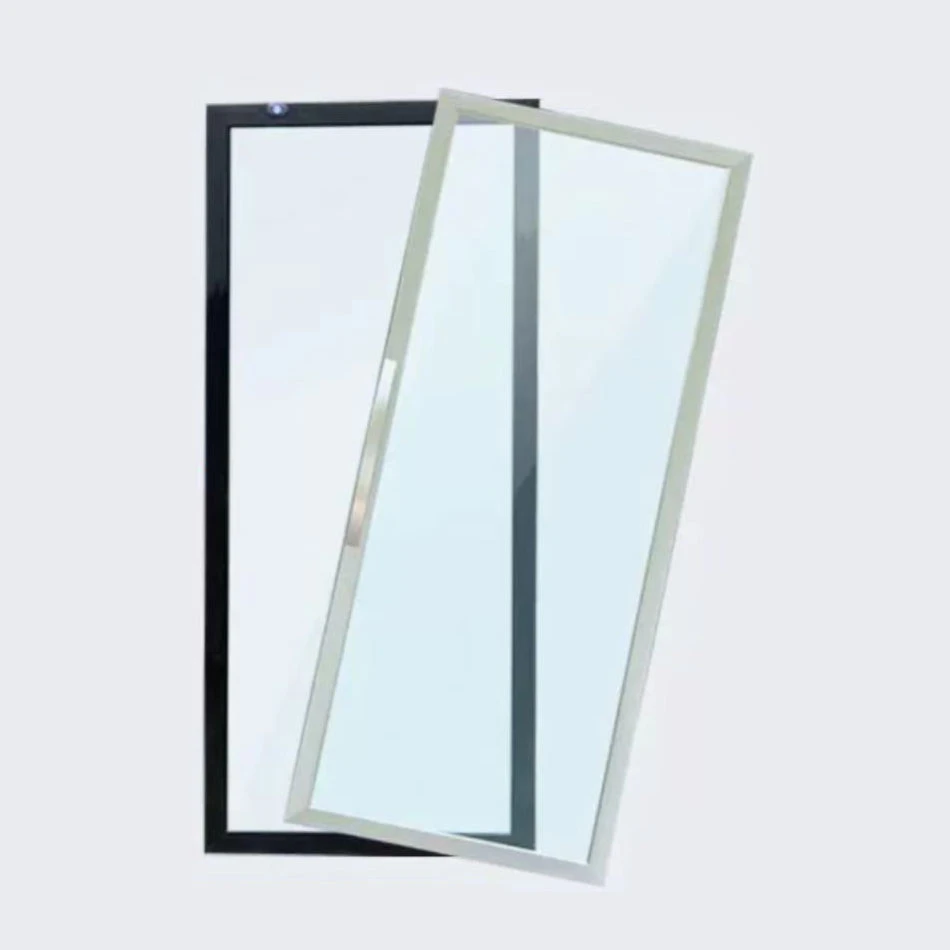
Three sample rounds ran over ten weeks. Round one proved touch activation through the glass but showed inconsistent sensitivity at the top zone — solved by adjusting the sensor ground plane, not the glass. Round two added the LED halo and passed dimensional fit on the reference cabinet on first attempt. Round three was built with production tooling and entered the full validation suite: 10,000 touch cycles, 10,000 door cycles, climate chamber exposure across the cellar humidity range, and thermal cycling between storage and room temperatures.
The third round is the one that matters. Building it with production tooling caught a harness routing interference that the prototype harness had avoided only by luck — a nine-dollar clip and a drawing revision, found before 3,000 doors instead of after.
Mass production shipped in three batches over the remaining months of the six-month program. The brand's incoming quality data across the first two quarters of service showed the following outcomes.
| Metric | Outcome |
|---|---|
| Touch activation accuracy | Consistent across zones after per-build calibration |
| Condensation | No visible fog in service across the humidity range |
| LED uniformity | Passed brand photometric standard on first approval |
| Line defect rate | Below 0.8% across three batches |
| Delivery | 3,000 doors in three on-time batches, 6-month cycle |
The commercial result mattered as much as the quality data: the refreshed line moved up a price tier at retail, with the glass door front cited in the brand's own launch materials.
Q: Does touch control work reliably through insulated glass?
A: Yes — with per-build sensitivity calibration against the actual glass stack and a sensor layout designed for the pane construction. Treat any supplier who promises "it just works through any glass" with caution; ask for their calibration procedure.
Q: Should every model in a line get a touch door?
A: No. Entry models often keep mechanical controls for cost discipline while premium tiers carry the touch door. A manufacturer producing both standard and electronic glass doors on one platform lets you tier the line without splitting suppliers — and the same platform extends to digital temperature controls and matching hardware.
The broader lesson: door-level integration projects succeed when the glass maker owns the glass, the lighting, the sensing integration and the harness under one roof. Huayin Glass Solutions has run this full-chain model from its Foshan facility since 2002 — see the manufacturing page and featured projects for capability background.
Planning a touch-control or lit glass door program? Send your platform drawings to our engineering team via the contact page for a free DFM assessment and sample quotation.
Further reading: ITO glass vs defogging coating · Client cases · Product range
Add:No. 16 Xingye Road, Beijiao Town Industrial Park, Shunde District, Foshan City, Guangdong Province
PHONE: +86 13509957538
TEL: +86 0757-26131933
Email: huayin_glass@163.com

© 2026 Huayin Glass Solutions All Rights Reserved.


