


 Add:No. 16 Xingye Road, Beijiao Town Industrial Park, Shunde District, Foshan City, Guangdong Province
 PHONE: +86 13509957538
 TEL: +86 0757-26131933
 Email: huayin_glass@163.com

Chinese


Insulated glass door assemblies for commercial freezers rely on three interdependent subsystems: the spacer that maintains pane separation, the gas fill that suppresses convective heat transfer, and the edge seal that prevents moisture ingress and gas loss. This brief defines each subsystem, lists the parameters that govern performance, and provides a specification checklist for buyers sourcing freezer glass door sealing and insulation from China manufacturers.
The spacer is the structural frame that holds the two (or three) glass panes apart. Its material and geometry determine how much heat bypasses the gas cavity through conduction at the perimeter.
Traditional aluminum spacers are stiff and low-cost but highly conductive, creating a thermal bridge that lowers the effective U-value at the edge. Warm-edge spacers use stainless steel or composite materials with lower thermal conductivity, reducing heat loss at the perimeter by 10–20 percent.
For freezer doors, cavity depths of 12–16 mm are common. Wider cavities improve insulation up to a point, but beyond approximately 16 mm the benefit diminishes because convective loops within the cavity begin to offset the gain. The optimal width depends on gas fill and pane thickness.
| Spacer type | Thermal conductivity | Relative edge U-value | Typical application |
|---|---|---|---|
| Aluminum box | High | Baseline (1.0×) | Budget freezer doors |
| Stainless steel warm-edge | Moderate | 0.85–0.90× | Mid-range display cabinets |
| Composite warm-edge | Low | 0.80–0.85× | High-performance freezer doors |
The gas between panes suppresses convective heat transfer. Air is the default but performs poorly because its thermal conductivity is relatively high and it contains moisture that can condense on cold surfaces.
Argon is the industry standard for insulated freezer doors. It is inert, non-toxic, and has lower thermal conductivity than air. A properly filled argon cavity improves the center-of-glass U-value by approximately 0.2–0.3 W/(m²·K) compared to air.
Initial fill rates above 90 percent are typical for production lines. The critical specification is not the initial fill but the long-term retention. Gas loss occurs primarily through the edge seal; a well-designed seal maintains above 80 percent argon concentration over a 10-year service life.
Argon-filled insulated glass is a standard offering for commercial freezer and display cabinet applications at Huayin Glass Solutions.
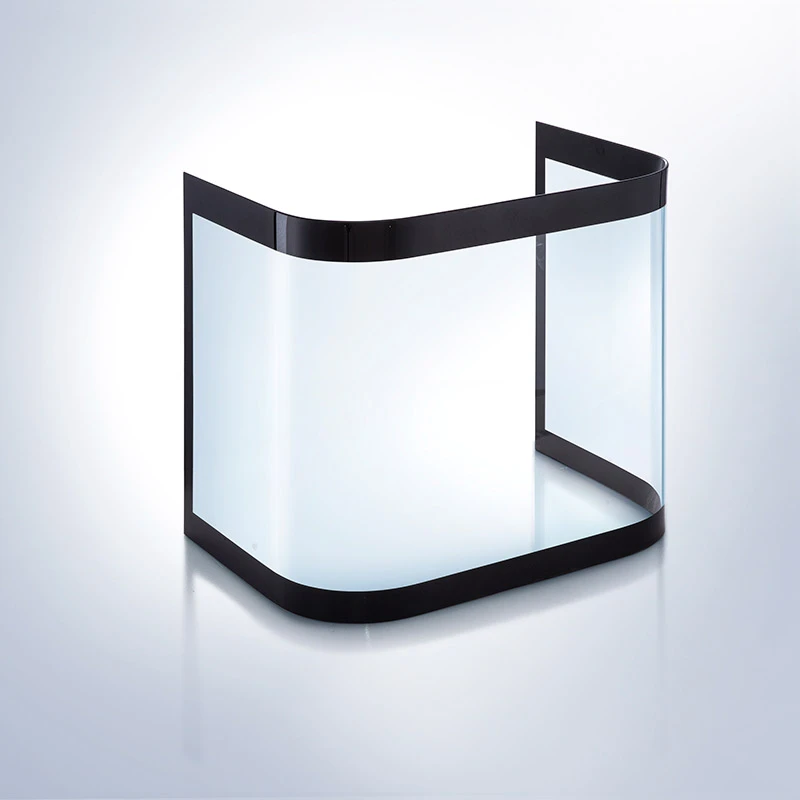
The edge seal is a multi-layer barrier: primary seal (polyisobutylene, PIB), secondary seal (structural silicone or polysulfide), and desiccant within the spacer channel. Each layer serves a distinct function.
PIB is applied as a continuous bead between the spacer and each glass pane. Its sole job is to block water vapor. Any gap or thinning in this bead creates a path for moisture to enter the cavity, leading to internal condensation — the visible fog between panes that cannot be wiped away.
The secondary seal holds the assembly together mechanically and provides a second line of defense against gas loss. Silicone secondary seals offer the best durability and UV resistance but require controlled application conditions. Polysulfide is easier to apply but less durable under thermal cycling.
Desiccant beads inside the spacer absorb residual moisture from manufacturing and any minor ingress during service life. The quantity of desiccant must be sized to the cavity volume; undersizing leads to premature saturation and fogging.
The overall U-value of a freezer door assembly is determined by the combination of center-of-glass performance, edge effects, and frame conduction. For the glass portion alone, the following parameters are adjustable.
| Parameter | Typical range | Impact on U-value |
|---|---|---|
| Pane thickness | 3–5 mm per pane | Thicker panes reduce conduction marginally |
| Cavity depth | 12–16 mm | Optimal around 14–16 mm with argon |
| Gas fill | Air or argon | Argon improves by 0.2–0.3 W/(m²·K) |
| Low-E coating | Surface 2 or 3 | Reduces radiative heat transfer significantly |
| Spacer type | Aluminum or warm-edge | Warm-edge improves edge U-value by 10–20% |
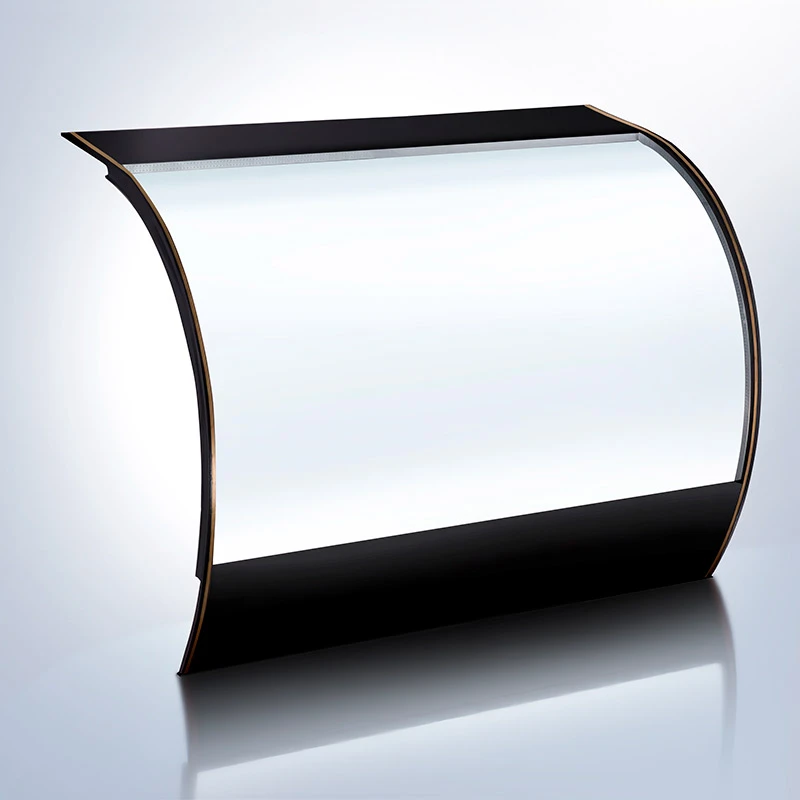
The edge zone of an insulated glass door is the weakest thermal point. Even with warm-edge spacers, the edge U-value is typically 30–50 percent higher than the center-of-glass value. In high-humidity environments, this creates a condensation risk at the perimeter.
Mitigation strategies include: extending the door frame to cover the edge zone, improving store air circulation, and selecting a spacer with the lowest practical thermal conductivity. For severe climates, triple-pane freezer glass with dual cavities provides additional margin.
Supplying the first five items is usually sufficient for a manufacturer to return a performance estimate and manufacturability assessment.
| Term | Definition |
|---|---|
| U-value | Rate of heat transfer through the assembly per unit area and temperature difference; lower is better |
| Warm-edge spacer | Spacer material with lower thermal conductivity than aluminum, reducing edge heat loss |
| Argon fill | Inert gas injected between glass panes to suppress convective heat transfer |
| Primary seal (PIB) | Polyisobutylene bead that forms the moisture barrier between spacer and glass |
| Secondary seal | Structural adhesive that bonds the assembly and provides gas retention |
| Desiccant | Moisture-absorbing material inside the spacer channel |
| Low-E coating | Thin metallic layer that reflects infrared radiation while transmitting visible light |
Q: How do I verify argon fill rate in production?
A: Request spark emission spectroscopy or gas chromatography test reports on sample lots. For ongoing production, specify a minimum initial fill rate (typically 90 percent) and ask for periodic retest data.
Q: What is the most common failure mode in freezer door seals?
A: Primary seal thinning or desiccant saturation leading to internal fogging. Both are manufacturing-control issues rather than design issues. Verify the supplier's automated seal application and desiccant filling processes during a factory audit.
Huayin Glass Solutions produces commercial supermarket freezer glass and wine cooler cabinet glass with automated insulated glass lines, warm-edge spacer options, and argon fill capability. Manufacturing is conducted in a 6,000+ square meter facility in Foshan, Guangdong, China, certified to ISO 9001:2015 and China CCC.
Send your door dimensions and U-value target for a technical assessment: contact our engineering team.
Further reading: Hot bent insulated heating glass · Manufacturing capability · ITO vs defogging coating comparison
Add:No. 16 Xingye Road, Beijiao Town Industrial Park, Shunde District, Foshan City, Guangdong Province
PHONE: +86 13509957538
TEL: +86 0757-26131933
Email: huayin_glass@163.com

© 2026 Huayin Glass Solutions All Rights Reserved.


