


 Add:No. 16 Xingye Road, Beijiao Town Industrial Park, Shunde District, Foshan City, Guangdong Province
 PHONE: +86 13509957538
 TEL: +86 0757-26131933
 Email: huayin_glass@163.com

Chinese


Every induction cooker, wall-hung boiler, and water heater sold today relies on a glass panel that must survive thermal shock, resist scratches, and keep its printed markings intact for years. For buyers sourcing home appliance glass panels from China, the real risk is not price — it is consistency. A supplier that delivers perfect first samples can still fail at volume if its process control is weak. This guide walks through the six manufacturing stages that determine whether a glass panel batch ships on spec or ends up in rework.
The first step turns raw float glass into the rough shape of the panel. For appliance glass, CNC cutting is preferred over manual scoring because it holds tighter tolerances on radius corners, notch cuts, and hole positions.
At this stage the buyer should confirm two things: the cutting tolerance (typically ±0.2 mm for appliance panels) and the edge finish required for downstream processes. A panel that will receive silk-screen printing needs a clean, chip-free edge; a panel that will be tempered needs enough margin around holes to avoid stress concentrators that can cause breakage in the tempering furnace.
After cutting, the panel moves to edge grinding and hole drilling. Straight edges are handled by double-edge grinding machines; complex curves and cutouts use waterjet or CNC machining centers. For water heater glass panels with rounded profiles, waterjet cutting is often the only way to achieve the required radius accuracy without micro-cracks.
Hole drilling deserves special attention. A drilled hole in tempered glass cannot be modified later, so the hole pattern must be finalized before tempering. The distance from hole edge to glass edge, and from hole to hole, must respect minimum spacing rules — usually at least 1.5 times the glass thickness — to prevent fracture during thermal treatment.
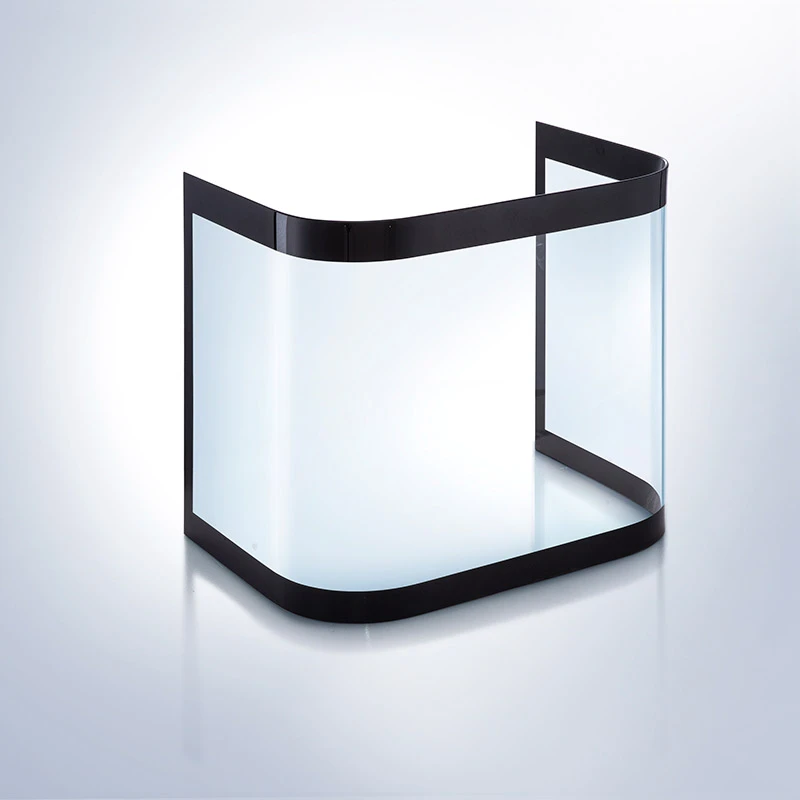
Tempering determines the mechanical and thermal strength of the finished panel. Appliance glass is typically heat-strengthened or fully tempered to 90–120 MPa surface compression. The tempering furnace must apply uniform airflow; uneven heating creates visible roller wave or optical distortion, which is unacceptable for panels that sit under kitchen lighting.
For panels with large cutouts or asymmetric shapes, the quench rate must be tuned to avoid breakage. This is why experienced home appliance glass manufacturers run small furnace loads for complex parts rather than maximizing throughput at the cost of yield.
This stage gives the panel its color, branding, and functional surface. There are three common treatments: back painting, ceramic ink screen printing, and anti-fingerprint / anti-scratch coatings.
Black, white, and metallic appliance panels are usually back-painted with epoxy or polyurethane paint. Color consistency depends on paint batch, spray pressure, and curing temperature. Reputable suppliers keep paint mixing records and bake samples with each batch to catch drift before it reaches mass production.
LOGOs, power ratings, warning symbols, and decorative patterns are screen-printed with ceramic ink and fired into the glass surface. Unlike organic ink, ceramic ink fuses into the glass and will not peel under heat. The critical control point is registration accuracy: each printed layer must align with the cut edges and with previous print layers.
Some induction cooker glass panels receive anti-scratch or hydrophobic top coatings. These add cost and must be tested for adhesion and wear resistance before volume application.

Quality control happens at four points: incoming glass inspection, after cutting/grinding, after tempering, and before shipment. Each checkpoint uses a different tool set.
| Checkpoint | Typical Test | Acceptance Rule |
|---|---|---|
| Incoming glass | Visual, thickness, bow | No bubbles, thickness ±0.2 mm |
| After machining | CMM / 2D vision | Hole position ±0.2 mm |
| After tempering | Surface stress meter | ≥90 MPa compression |
| Before shipment | Colorimeter, visual | ΔE ≤1.0 vs approved master |
Even a perfectly manufactured panel can be ruined by poor packing. Appliance glass panels are usually stacked with PE foam separators, wrapped in shrink film, and loaded into plywood crates or corrugated cartons with corner protectors. For export orders, humidity indicators and VCI film may be added to prevent edge corrosion during sea freight.
The buyer should request packing photos before shipment and confirm that the crate marking matches the production batch. Mixed batches in one crate create receiving chaos at the assembly plant and increase the risk of wrong parts being installed.
Procurement teams rarely visit the factory for every order, but they can ask for documented evidence at each stage. Request these items before placing volume orders:
A supplier that cannot provide these records is unlikely to hold tolerance across 10,000+ pieces.
Buying home appliance glass panels is not only about the final drawing. The drawing tells you the shape; the process tells you whether that shape will repeat 50,000 times. Buyers who specify only dimensions and price get exactly what they ask for — and often a lot of downstream problems they did not.
The most reliable China glass panel manufacturers are those who can explain, and document, every stage from cutting to crate. Huayin Glass Solutions, established in 2002 in Foshan, Guangdong, operates 6,000+ square meters of glass deep-processing capacity serving appliance brands in 50+ countries. If you are sourcing wall-hung boiler glass panels, induction cooker panels, or steamed-bun machine glass, contact our engineering team for a free DFM review and sample quotation.
Further reading: Home appliance glass panels · Manufacturing capability · Featured projects
Add:No. 16 Xingye Road, Beijiao Town Industrial Park, Shunde District, Foshan City, Guangdong Province
PHONE: +86 13509957538
TEL: +86 0757-26131933
Email: huayin_glass@163.com

© 2026 Huayin Glass Solutions All Rights Reserved.


