


 Add:No. 16 Xingye Road, Beijiao Town Industrial Park, Shunde District, Foshan City, Guangdong Province
 PHONE: +86 13509957538
 TEL: +86 0757-26131933
 Email: huayin_glass@163.com

Chinese


Send one drawing to three China freezer glass door manufacturers and the unit prices can land far apart. The gap is rarely pure margin. In most cases each factory has counted a different set of cost lines: one has priced tooling into the unit, another defers it to a separate invoice, and a third leaves export packing and inland haulage out entirely. The checklist below separates those lines so the quotes become comparable.
Key takeaways
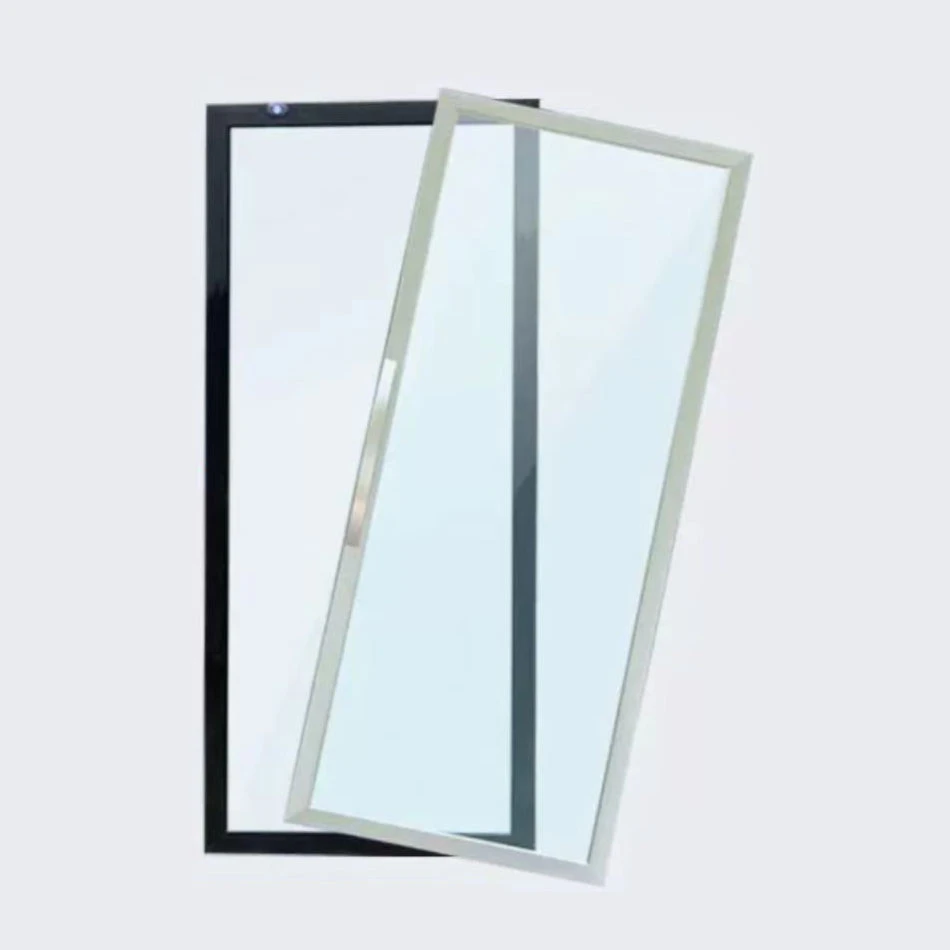
A freezer glass door is an assembly, not a single part. Two suppliers reading the same drawing may assume different substrate brands, different pane counts, different hinge hardware and different test requirements. Each assumption is defensible on its own, which is why the numbers still look reasonable until the doors arrive.
The practical fix is not to negotiate harder. It is to ask every candidate to quote against the same six cost lines, then compare rows rather than totals. Suppliers who refuse to break the number down are telling you how they will handle the first problem shipment.
Use the matrix below as the structure of your request for quotation. If a supplier returns a single number, send this table back with the empty columns and ask them to fill it in.
| Cost item | What it covers | What to check | Red flag |
|---|---|---|---|
| Tooling and samples | Bending moulds, silk screens, CNC templates, sample pieces | One-off price and whether it converts against volume | No mention of tooling at all |
| Glass build and coating | Pane count, thickness, Low-E, argon fill, ITO heating | Whether the coating comes with a data sheet | No producer or coating specification named |
| Frame and hardware | Aluminium profile, gasket, hinge, handle, LED strip | Profile wall thickness and finish standard | Only a bundled hardware price given |
| Processing steps | Cutting, edging, drilling, tempering, printing, IG assembly | Which steps run in-house versus outsourced | Factory declines to list equipment |
| Export packing | Crate type, interleaving, corner and edge protection | Pieces per crate and crate material | Packing described simply as export standard |
| Freight and terms | Inland haulage, port charges, applicable Incoterm | Named port and named Incoterm | FOB inclusive with no port identified |
Two numbers leave this table and land in almost every dispute later: whether the manufacturer owns the coating and tempering assets, and what the packing actually consists of. Both are inexpensive to ask about and expensive to discover after shipment.

Tooling applies wherever the factory cannot use an existing fixture. Typical cases include a bending mould for a new radius, a screen mesh for your logo artwork, and a CNC template for irregular holes or hinge cut-outs. These are genuine one-off costs, and they are the reason the second batch costs less than the first.
The question worth asking is ownership. Confirm in writing whether the mould stays available to you for repeat orders, whether there is a re-order validity period, and whether the tooling charge converts against a defined volume. A supplier who keeps tooling records tied to your part number is also the supplier who can rebuild a batch matching a door delivered two years ago. That matters most on branded builds such as a custom logo glass door or a rounded corner print door with perimeter lighting, where artwork registration has to stay identical across campaigns.
Machine set-up is a fixed cost. Film selection, mould changeover, printing registration and tempering furnace loading all consume time regardless of whether the batch is fifty doors or five thousand. MOQ exists because below a certain quantity the set-up cannot be spread thin enough to hold the unit price.
Lead time follows the same logic. A build that needs raw float in a non-standard thickness, an ITO coating slot, or a curved panel programmed on the bending furnace has queue dependencies you cannot compress by asking. Factories publishing real schedules explain which queue each stage sits in. The most reliable short answer anyone can give you comes from a plant that runs cutting, edging, tempering, printing and insulating under one roof rather than across four subcontractors — see how a vertically integrated glass plant is laid out before accepting any promise.
Moving from double glazing to a triple-pane build, or adding Low-E plus argon, raises both material and processing cost. It also changes the thermal result, so the decision should start from the required U-value for the destination climate rather than from the price sheet. Supermarket freezer glass running in tropical humidity needs a different build from the same cabinet in a climate-controlled store.
A flat pane needs no mould. A single-radius curved pane needs one; a multi-curvature panel needs a more complex one again. Where the design allows, standardising radii across a cabinet family removes tooling from several SKUs at once.
Irregular waterjet cut-outs, countersunk hinge holes and multi-colour ceramic prints each add fixturing and inspection time. None is expensive alone, but a specification asking for all three on a small batch will price like a large one.
Two quotes are comparable only when pane count, coating, hardware and test scope match. If they do not, the cheaper number is simply a thinner door.
A sample that is approved verbally and not retained becomes useless in a dispute. Keep one signed piece from each party covering print colour, edge finish and hardware position.
Terms decided after production starts expose the buyer to inland haulage, port handling and documentation charges nobody budgeted. Name the port — Nansha, Huangpu or Beijiao — inside the quote itself.
Need a quote you can put against another line by line? Send your drawing and target quantity to Huayin Glass Solutions. Huayin Glass has produced custom glass since 2002 in Beijiao, Shunde, Foshan, Guangdong, operating 6,000+ square metres under ISO 9001:2015 and China CCC, with hardware such as magnetic gaskets and self-closing hinges sourced as a matched set. Shipments leave through Nansha, Huangpu and Beijiao ports to markets across Southeast Asia, the Middle East, Africa, the Americas and Europe.
Further reading: Product range · Client programmes · ITO heated glass versus anti-fog coating
Add:No. 16 Xingye Road, Beijiao Town Industrial Park, Shunde District, Foshan City, Guangdong Province
PHONE: +86 13509957538
TEL: +86 0757-26131933
Email: huayin_glass@163.com

© 2026 Huayin Glass Solutions All Rights Reserved.


