


 Add:No. 16 Xingye Road, Beijiao Town Industrial Park, Shunde District, Foshan City, Guangdong Province
 PHONE: +86 13509957538
 TEL: +86 0757-26131933
 Email: huayin_glass@163.com

Chinese


Curved glass for commercial refrigeration reaches its shape by one of two routes. In hot bending, a flat panel is formed at elevated temperature and allowed to cool slowly, leaving it annealed. In curved tempering, the formed panel is quenched so a compressive stress layer develops at both surfaces. Both routes produce curves that look identical on a drawing; they differ in residual stress state, fragment behaviour, thermal shock resistance and safety classification. This brief sets out the process windows, the measured performance differences, coating compatibility, and the selection logic used when specifying curved glass for freezer and display cabinets.
The panel is heated past its softening point on a shaped mould, gravity or a mechanical assist brings it to profile, and it is then cooled under controlled conditions. The product is annealed curved glass: geometrically stable, low in residual stress, and cuttable or edge-workable after forming in many cases.
Forming is followed immediately by a high-pressure quench on both faces. The surface layer solidifies first while the core is still plastic, and as the core subsequently contracts it places the surfaces in compression. The result is curved tempered glass with a stress profile comparable to flat tempered glass.
Annealed bent glass appears where the curve is decorative and the panel is protected, such as interior display covers. Tempered curved glass is used where the panel is a loaded or safety-relevant component: freezer door lites, pastry cabinet fronts, and heated door panels.
Both routes begin with a heated mould cycle. The difference is what happens next: hot bending continues into an annealing lehr, while curved tempering transfers the panel directly into a quench section with matched upper and lower air bars.
Quench uniformity governs two outcomes that buyers notice in the field: optical quality and edge flatness. Non-uniform quench produces anisotropy patterns visible under display lighting, and can leave bow at the straight edges that interferes with gasket seating.
| Stage | Hot bending (annealed) | Curved tempering |
|---|---|---|
| Forming | Mould cycle at softening temperature | Mould cycle at softening temperature |
| Cooling | Controlled annealing lehr | High-pressure air quench, both faces |
| Post-forming work | Cutting, drilling, edge work possible | None — all processing must precede tempering |
| Tooling | Mould per radius, lower cost | Mould plus quench fixture per radius |
| Cycle length | Longer cool-down | Shorter quench, tighter timing window |
| Property | Hot bent (annealed) | Curved tempered |
|---|---|---|
| Bending strength | Baseline | Several times baseline |
| Thermal shock resistance | Low | High |
| Breakage pattern | Large, sharp fragments | Small, blunt fragments |
| Edge quality after forming | Can be re-worked | Fixed at quench |
| Optical distortion risk | Lower | Slightly higher, quench dependent |
| Safety classification | Not a safety glass | Classified as safety glass |
The thermal shock row is the one that decides most refrigeration specifications. A heated door panel cycles between ambient and chilled conditions continuously; annealed bent glass is not an appropriate substrate for that duty.

Radius capability is a function of thickness, panel size and whether the curve is single-axis or compound. Thin glass allows tighter radii; thick glass and compound curvature push the practical limit outward. The table below is a working reference for single-axis curves — final feasibility is always confirmed against the actual drawing.
| Nominal thickness | Practical minimum radius | Notes |
|---|---|---|
| Thin (3–4 mm) | Tight radii achievable | Common for small display covers |
| Medium (5–6 mm) | Moderate radii | Standard range for cabinet fronts |
| Thick (8 mm and above) | Large radii only | Forming window narrows sharply |
| Compound curvature | Case by case | Requires dedicated tooling and trial panels |
Buyers should supply chord length and rise, or a 1:1 template, rather than a radius alone. That single practice removes most of the ambiguity in first-round feasibility checks.
Coating curved glass introduces a uniformity problem that flat lines do not have: the deposition source sees a varying surface angle. Low-E layers on curved panels must be qualified for the specific radius, otherwise emissivity varies across the panel. Coated curved tempered glass is normally validated by measuring emissivity at several positions rather than one.
ITO conductive film follows the same rule. Sheet resistance is uniform only if deposition is uniform; on a tight radius that requires process adjustment. Because the film is fired during the tempering cycle, heated curved glass must be tempered — which removes annealed bent glass from consideration for any heated door application. See the technical comparison of ITO heated glass and applied defogging coatings for the control-side trade-offs.
Curved panels are combined into insulated units for chilled cabinets and into laminated units where a retained-fragment behaviour is required. Hot bent insulated heated glass pairs a curved outer pane with a heated layer; hot bent laminated glass addresses applications where post-breakage retention matters more than thermal shock.
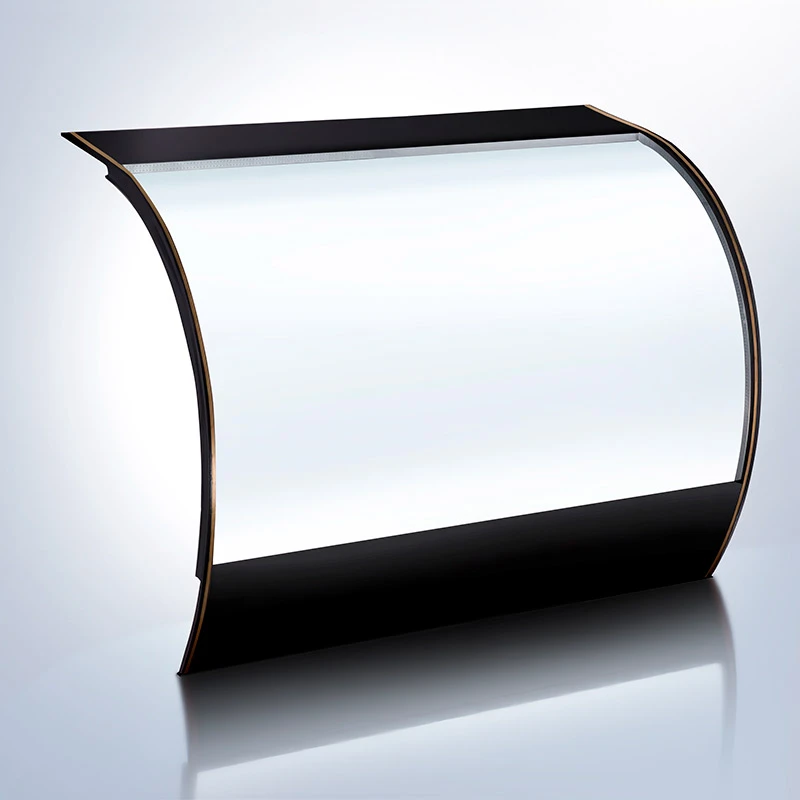
Curved tempered glass is classified as a safety glazing material once it meets the fragment and impact requirements of the applicable standard. Buyers importing into regulated markets should state the destination standard at inquiry stage, because fragment count thresholds and impact test methods differ between jurisdictions.
Annealed bent glass carries no such classification. Where a cabinet design places curved glass within reach of consumers, or where the panel is part of a door assembly, specifying tempered construction is the safer route and is the specification most distributors now require.
| Application condition | Recommended route | Reason |
|---|---|---|
| Door panel on chilled or frozen cabinet | Curved tempered, usually insulated | Safety glass plus thermal shock resistance |
| Panel carries a heating layer | Curved tempered only | Film is fired during the tempering cycle |
| Decorative interior cover, no load | Hot bent annealed | Lower tooling cost, re-workable edges |
| Tight radius on thick glass | Evaluate both, expect tooling trials | Forming window narrows with thickness |
| Post-breakage retention required | Curved tempered laminated | Fragments retained by the interlayer |
In practice most commercial refrigeration inquiries fall into the first two rows, which is why thermally bent glass supplied for cabinets is almost always supplied in tempered form.
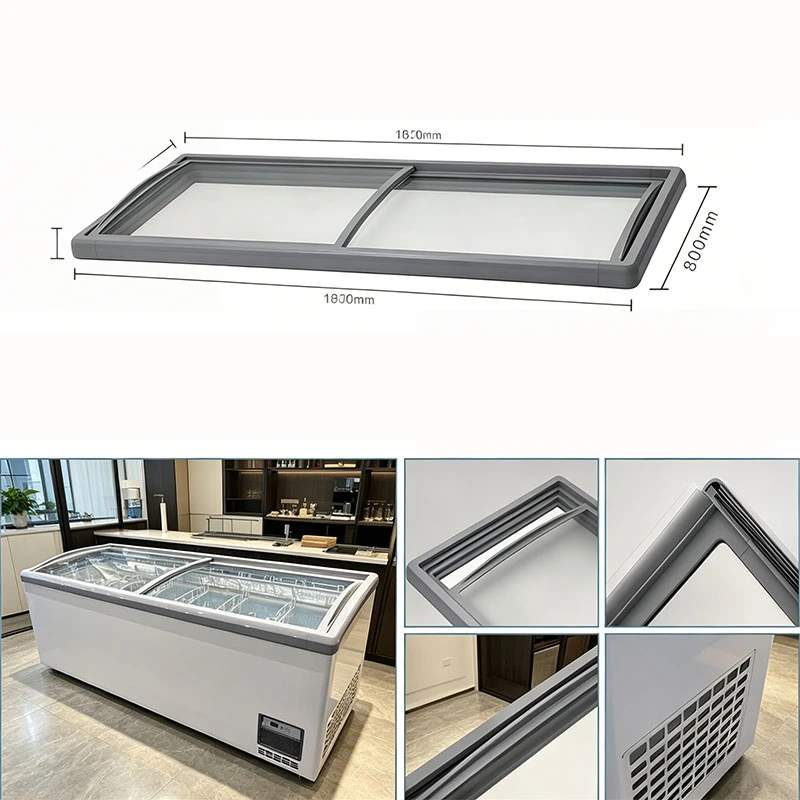
| Term | Definition |
|---|---|
| Annealed glass | Glass cooled under controlled conditions, free of significant residual stress |
| Tempering | Rapid quenching that places the surfaces in compression and the core in tension |
| Chord and rise | Straight-line span and maximum deviation of an arc; used to derive radius |
| Compound curvature | Curvature in more than one axis on a single panel |
| Emissivity | Surface property governing long-wave radiative heat exchange; Low-E targets it |
| Anisotropy | Visible strain pattern in tempered glass under polarised or display lighting |
Q: Can an existing flat drawing be converted to a curved panel without a new mould?
A: Only if the radius matches tooling already held by the factory. Otherwise a mould and, for tempered construction, a matched quench fixture are required. Supplying chord and rise at inquiry stage lets the factory check existing tooling before quoting.
Q: Is curved tempered glass always necessary for cabinet fronts?
A: For door assemblies and any heated panel, yes. For a purely decorative interior cover that carries no load and is not heated, annealed bent glass performs adequately and costs less in tooling.
Huayin Glass Solutions has produced curved and thermally bent glass since 2002, operating a 6,000 m² facility in Shunde, Foshan, with ISO 9001:2015 and China 3C certification and shipments to more than 50 countries. Send chord, rise, thickness and application conditions for a manufacturability assessment — request a drawing review and sample quote.
Further reading: Hot bending glass · Coated curved tempered heated IG glass · Freezer glass · Manufacturing capability · Featured projects
Add:No. 16 Xingye Road, Beijiao Town Industrial Park, Shunde District, Foshan City, Guangdong Province
PHONE: +86 13509957538
TEL: +86 0757-26131933
Email: huayin_glass@163.com

© 2026 Huayin Glass Solutions All Rights Reserved.


