


 Add:No. 16 Xingye Road, Beijiao Town Industrial Park, Shunde District, Foshan City, Guangdong Province
 PHONE: +86 13509957538
 TEL: +86 0757-26131933
 Email: huayin_glass@163.com

Chinese


A beverage brand's cooler is its most repeated brand impression: every shop that stocks the product becomes a billboard, and the glass door is the billboard's surface. When a European drinks brand decided to standardize its cooler fleet across three countries, the door design — rounded corners, a screen-printed brand band, and perimeter LED lighting — had to survive mass production without losing the shelf appeal of the showroom prototype. This case study walks through how the rounded-corner screen-print glass door program moved from artwork file to 3,000 delivered doors.
The brand's pain was familiar: coolers sourced from several regional suppliers looked inconsistent in-store. The same brand color printed visibly different from one door batch to the next, corner radii varied, and LED strips from third-party vendors matched no door's frame on the assembly floor. Procurement consolidated the door program into a single OEM specification.
The brand's design team measured the problem before rewriting the spec. Across 12 sampled doors from three incumbent suppliers, the printed brand color deviated noticeably between doors, and two suppliers' corner radii differed from the design file by a visible margin. On a shelf wall where ten coolers sit side by side, the inconsistency was obvious to any customer.
Screen printing on glass was the root cause. Ink is fused to glass at high temperature, and the fired color depends on ink batch, furnace atmosphere and squeegee pressure — controls most small print shops never measure. The brand needed a manufacturer that treats printing as a process with recorded parameters, not a decorative afterthought.
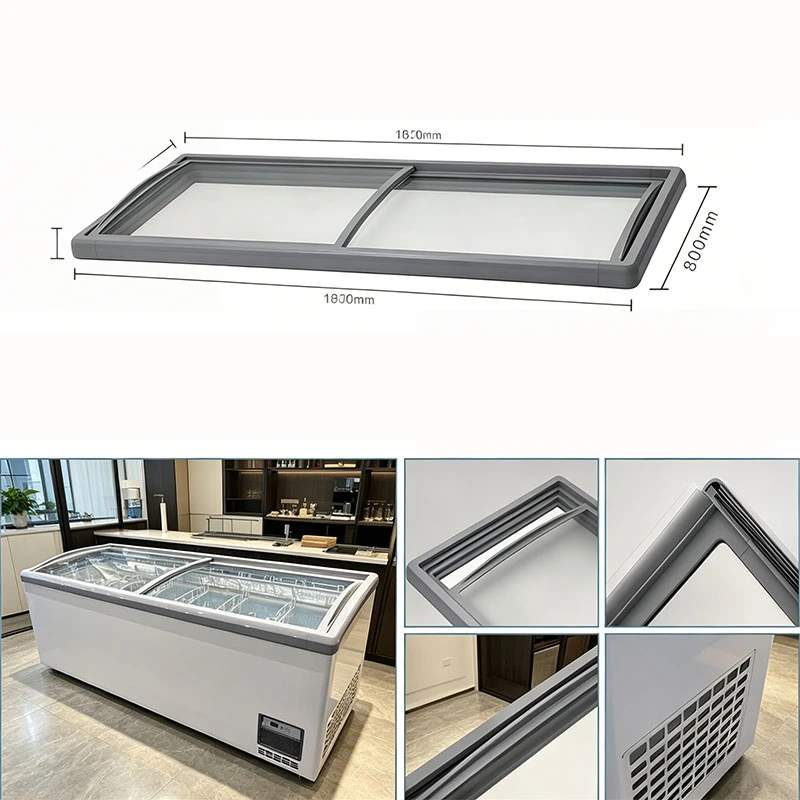
The design team's brand book speaks in Pantone numbers; a glass line speaks in ink formulations, corner radii and lumen outputs. The procurement team converted the guidelines into the following measurable requirements.
| Requirement | Target | Why it mattered |
|---|---|---|
| Printed color consistency | Batch color difference ΔE ≤ 1.5 (D65) | Same brand color on every door, every country |
| Corner radius | R specified, tolerance ±0.5 mm | Uniform silhouette across the cooler fleet |
| Print adhesion | Ceramic ink, 3M tape test pass | No fading or flaking over years of cleaning |
| Lighting | Perimeter LED integrated in frame, matched output | Consistent shelf glow; no third-party strips |
| Insulation | Double-pane tempered, Low-E option per market | Energy compliance for European retailers |
After reviewing sample doors from several manufacturers, the brand approved a door built around a rounded-corner screen-print glass door with perimeter LED, tempered in a forced-convection furnace and printed with ceramic ink fused during tempering.
All doors for the program print from a single screen plate held by the manufacturer, with the ink formulation recorded and reused per batch. Fired samples from every production batch are compared against a retained color standard, which is how the ΔE ≤ 1.5 target is enforced in practice rather than promised in a quotation.
Instead of retrofitting strips, the perimeter LED runs inside the anodized aluminum frame with a defined connector interface. The brand's earlier fleets suffered from mismatched strip colors and adapters; sourcing the door and lighting from one assembly line removed that failure mode. The same logic applies to branded beer cooler glass doors where the LOGO itself must glow.
Corner radii were shaped on CNC edging equipment before tempering, not hand-ground after. Post-tempering grinding weakens the edge; pre-tempering shaping keeps the surface compression intact and the radius repeatable to ±0.5 mm.
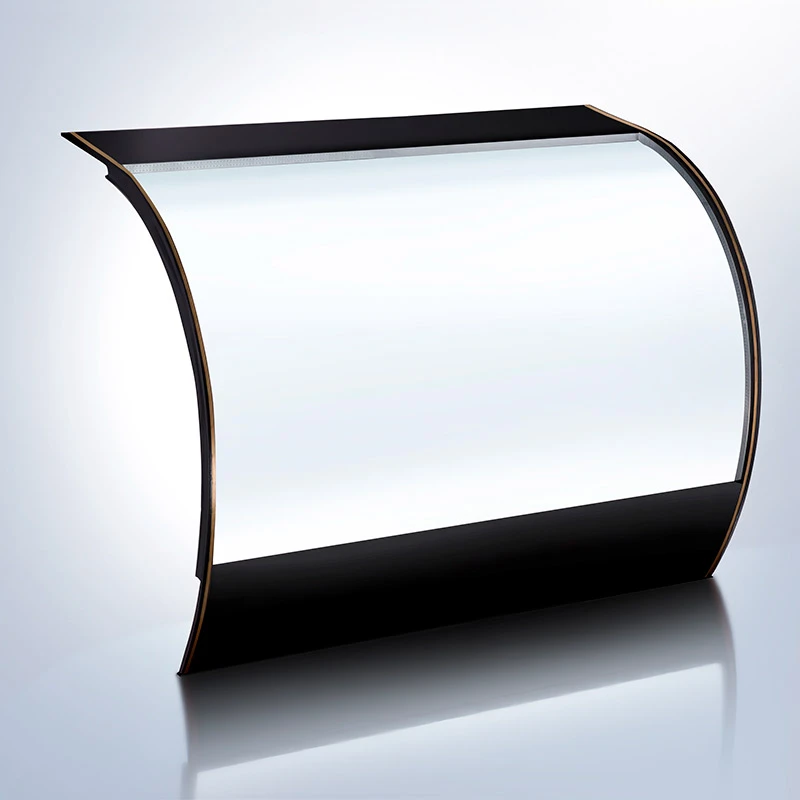
The program ran a 50-door pilot before releasing full production. Every pilot door passed three checks: fired color against the retained standard, print adhesion by tape test, and corner geometry on a fixed gauge.
The pilot surfaced one issue worth the calendar time: a slight print band offset when door orientation changed on the line. The fix — locking print orientation per pallet — was applied before mass production. Fire-and-forget printing is exactly what destroys brand consistency at volume.
Seven months after the program started, the brand's field reports across three countries looked like this.
| Metric | Outcome |
|---|---|
| Batch color deviation | Held within ΔE 1.5 across all production batches |
| In-store fleet appearance | Uniform across the three-country rollout |
| Print durability | No reported flaking or fading after first cleaning cycles |
| LED field failures | Notably lower than the previous multi-vendor setup |
| Assembly complaints at distribution | Reduced; doors arrived with matched lighting and hardware |
Q: Can we keep our current print shop and just buy glass?
A: You can, but you inherit every color-drift risk described above. When the print is part of the brand promise, print it where the parameters are recorded and verified per batch — this is standard practice at our manufacturing facility.
Q: Is a 50-door pilot worth the extra weeks?
A: In this program it caught a print-orientation offset before it reached 3,000 doors. Pilot runs cost weeks; unchecked issues cost markets.
The transferable lesson: turn brand guidelines into measurable glass parameters — color tolerance, corner radius, adhesion test, lighting interface — and source against those numbers, not against renders. See more of our work with global brands in featured projects.
Planning a branded door program? Send your artwork files and cooler dimensions to our engineering team via the contact page for a sample quotation and DFM feedback within 24 hours.
Further reading: Custom LOGO glass doors · Aluminum frame glass doors · ITO glass vs defogging coating
Add:No. 16 Xingye Road, Beijiao Town Industrial Park, Shunde District, Foshan City, Guangdong Province
PHONE: +86 13509957538
TEL: +86 0757-26131933
Email: huayin_glass@163.com

© 2026 Huayin Glass Solutions All Rights Reserved.


